


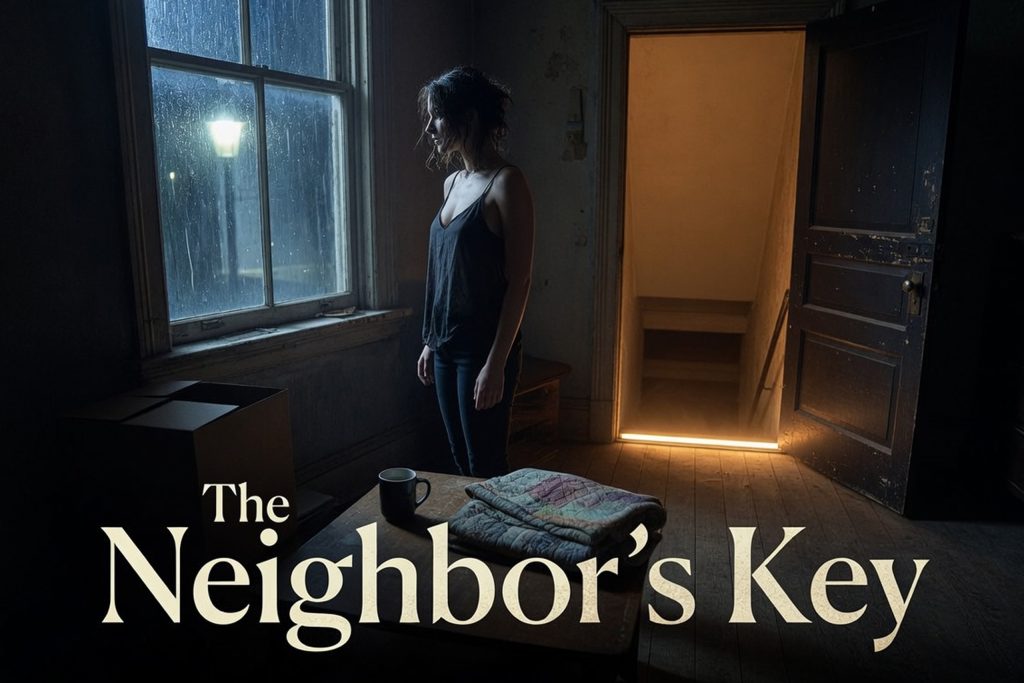
The boxes were lighter than they looked. Nora Ellison had packed them that way on purpose.
She set the last one down in the center of the upper unit and stood still long enough to hear the building settle around her. Rain had started while she was still carrying things up from the truck—soft at first, then steady against the windows. The place smelled of old wood and the previous tenant’s detergent, something floral that was already fading. She opened the nearest window a few inches and let the wet air push the scent out.
The floorboards under her socks were worn smooth in the places people walked most. She noticed that. She noticed the way the light from the streetlamp outside cut a clean rectangle across the empty living room. She noticed that the silence from the unit below was complete.
No television. No music. No footsteps. Just the rain and the soft creak of the building itself.
She had chosen the duplex because the listing said the lower tenant was quiet and rarely home. She had chosen it because the rent was low enough that she could keep working only the contracts she wanted. She had chosen it because it was on a street she didn’t know, in a neighborhood that didn’t know her, and because the previous tenant had left a single note taped to the inside of the front door:
*Spare key for the upper unit is with the downstairs neighbor if you ever need it. – E.*
Nora had folded the note once and put it in the pocket of her jeans. She had not gone downstairs.
Now, with the boxes stacked and the rain thickening, she took the note out again. The handwriting was precise, almost architectural—straight lines, even pressure. She turned it over. Nothing on the back.
She walked to the landing and looked down the stairs. The lower door was closed. A thin strip of warm light showed underneath. She stood there longer than she needed to, listening. Nothing moved.
She went back inside, closed her own door, and began the careful performance of settling in. She put the kettle on even though she wasn’t thirsty. She unfolded the thin quilt that always went on the bed first, the one that traveled well. She left the larger boxes sealed. Light packing was a habit older than this apartment, older than the last three. It made leaving feel like a decision instead of a loss.
Through the floorboards she heard a single, deliberate footstep.
She went still.
The man downstairs had been quiet when she toured the place. The landlord had called him “the architect,” as if that explained the stillness. Elias something. She hadn’t caught the last name. He had not come out to introduce himself. That had suited her. Introductions required explanations, and explanations required versions of herself that lasted longer than a lease.
The footstep came again, then stopped. Nora realized she was holding the edge of a box too tightly. She forced her fingers to loosen, finished making the tea she didn’t want, and carried the mug to the window. Rain silvered the street. Somewhere below, a door closed with the soft finality of someone who did not slam things.
She almost went downstairs to say she was the new upstairs. Almost. Instead she drank the tea, washed the mug, and stacked the empty boxes in the corner by the door where they would be easy to carry out again.
By ten the apartment was as settled as she intended to make it. One mug. One plate. The frying pan. The quilt. The laptop on the small desk that faced the window. She turned off every light except the one over the stove and stood in the near-dark, testing how the place felt when it was only hers. The floorboards under her bare feet were cool. Somewhere below, a single light stayed on in the hall. She could see the thin line of it under her own door when she looked.
She went to bed with the key note still in the junk drawer and the sound of rain filling the spaces where another person’s footsteps might have been.
Elias Thorne stood in the exact center of his living room and listened to the new weight of the building.
Footsteps. Not the previous tenant’s heavier, irregular tread. These were lighter, restless, stopping and starting as if the person above was measuring the space against an internal checklist. He had heard the car arrive in the afternoon. Had watched, from the edge of the curtain, a young woman unload boxes with the efficient movements of someone who had done it too many times. Dark hair pulled back. An oversized sweater that looked like it had been packed and unpacked through several cities. She did not look like someone who stayed.
He had kept the emergency key in the ceramic dish by the door for two years, three months, and eleven days. The previous tenant had never needed it. Elias had never offered it. It sat there the way certain tools sat in his studio—present, precise, unused. A contingency that proved he was still the kind of man who prepared for emergencies even if he no longer believed in them.
The footsteps paused directly above his bedroom.
Elias looked at the key. The ceramic was the color of old bone. The key itself was ordinary brass, slightly worn at the teeth. His late wife had bought the dish at a market the first year they lived here. She had liked objects that held other objects. He had liked the way she arranged them.
He did not pick the key up. He turned off the lamp in the front room instead, the way he did every evening at this hour, and went into the studio at the back of the unit. The model of the lakeside renovation waited under its dust cloth. He uncovered it, adjusted a single beam with the tip of a pencil, and listened to the rain and the new, careful footsteps above him until both became a kind of quiet he could almost trust.
When he finally went to bed he left the hall light on.
He told himself it was because the landing was dark. He did not examine the other reason: that the light might mean something to the person upstairs who packed light and moved like she was already halfway gone.
Outside, the rain kept falling. Above him, the new tenant slept or did not sleep. He could not tell which.
In the morning the power would still be on. The key would still be there. And the footsteps would start again.
He did not know her name yet.
He already knew the exact sound of her weight on the third stair from the top.
The storm arrived after midnight the way storms sometimes did in this part of the city—sudden, heavy, and absolute.
Nora woke to the sound of rain hitting the windows hard enough to rattle the frames. For a few seconds she lay still, listening, orienting herself in the unfamiliar dark. Then the power went out with a soft click that seemed to come from inside the walls, and the streetlamp rectangle on her floor disappeared.
Complete darkness.
She sat up. The only light left was the faint gray of the storm itself pressing against the glass. She reached for her phone on the nightstand and the screen flared too bright, casting her hand in blue-white. The battery was at twelve percent. She turned the flashlight on, got out of bed, and crossed to the window. Rain sheeted down the glass. Somewhere close, thunder rolled without the flash of lightning that should have preceded it.
A sharp crack sounded from the front of the building—wood or something heavier. Nora froze. The sound came again, lower this time, near the shared entry. Her first thought was the door. Her second was that she was alone in an apartment she had lived in for less than thirty-six hours and that the emergency key was downstairs with a man she had not yet spoken to.
She stood in the dark holding the phone, listening hard. The rain made it difficult to separate one sound from another. Then she heard footsteps on the stairs—measured, deliberate, coming up.
A soft knock on her door.
“It’s Elias,” a voice said. Male, quiet, precise. “From downstairs. Are you all right?”
Nora crossed the room and unlocked the door with fingers that felt colder than they should have. When she opened it, the hallway was black except for the small circle of light from her phone. He stood just outside the threshold, taller than she had expected, wearing a dark sweater, hair slightly damp as if he had already been outside or near an open window. In one hand he held a flashlight. In the other, the brass key.
“I’m fine,” she said. The words came out steady. She was not sure they were true.
“Something hit the front entry,” he said. “A branch, I think. I checked. The door’s still solid. Power’s out on the whole block.”
He did not step inside. He simply stood there, the key visible between his fingers, waiting to see whether she would close the door or not.
Nora looked at the key. Then she looked at him. In the uneven light his face was all angles and restraint. There was a pale band of skin on the ring finger of the hand that held the flashlight.
“Come in,” she said.
He stepped over the threshold. The air that came with him smelled of rain and clean soap and something fainter, like graphite or sawdust. He closed the door behind him with the same care he seemed to give every movement.
They stood in the dark of her living room with only the two small circles of light between them. Rain hammered the windows. Thunder moved through the building like a low continuous presence.
“I have candles,” Nora said, because the silence needed something practical to fill it. “Somewhere.”
“I brought matches.” He set the flashlight on the counter so its beam pointed at the ceiling, softening the shadows, and took a small box from his pocket. “And a battery lantern if you want it.”
She found the candles in the second box she opened—three white ones she had packed without quite knowing why. He lit them with the same precise economy he did everything else. The light changed the room. It made the stacked boxes look less temporary and the space between them smaller.
“You’re Nora,” he said. It was not a question.
“Yes.”
“Elias Thorne.”
She nodded. The name fit the handwriting on the note.
They stood listening to the storm. At some point the rain eased from a roar to a hard steady fall. The branch or whatever had struck the entry did not move again. Nora’s phone battery dropped to nine percent. She turned the flashlight off to save it.
“You should keep this,” Elias said. He held out the key.
Nora looked at it. The brass was dull in the candlelight. Ordinary. Heavy for its size.
“I don’t—” she began.
“In case the power stays out. Or the lock sticks. Or you need it.” His voice stayed level. “It’s not a problem. I have another.”
She took the key. Their fingers brushed—brief, accidental, enough that she felt the calluses on his fingertips and the residual coolness of the metal. She closed her hand around it.
“Thank you.”
He nodded once. Did not smile. Did not look away immediately.
The candles flickered. Somewhere outside, a car alarm started and then stopped. Nora realized she was still standing in the middle of the room in the oversized sweater she had slept in and that her hair was probably a mess and that none of that felt as important as the fact that he had come up the stairs in the dark and that she had not sent him away.
“I’ll check the entry again at first light,” he said. “If you hear anything before then—”
“I’ll use the key.”
“Yes.”
He turned toward the door. She almost asked him to stay until the storm passed. The words rose and then settled again without being spoken. He opened the door onto the black hallway, paused for half a second as if he might say something else, and then left. She listened to his footsteps go down the stairs, measured and unhurried. She listened until she heard the lower door close.
Only then did she look at the key in her palm.
It was still warm from his hand.
She set it on the counter beside the candles, within easy reach, and sat on the edge of the bed in the flickering light while the rain continued and the power stayed off and the building felt, for the first time since she had arrived, less empty than it should have.
In the morning the lights would come back. The storm would be over. The key would still be there.
She already knew she was not going to return it right away.
The power returned just after six with a soft electronic sigh that ran through the walls. Nora woke to the refrigerator humming again and the streetlamp rectangle gone, replaced by the thin gray light of a washed-out morning. Rain still fell, lighter now, steady and without drama.
The key sat on the counter where she had left it, brass dulled by the low light. She touched it once with the tip of one finger, as if checking that it was still real, then made coffee in the single mug she had unpacked. The apartment smelled of wet wood and the candles that had burned down to stubs.
She did not put the key away.
At half past seven she heard movement on the stairs—measured, familiar already. A soft knock, the same weight as the night before.
“It’s Elias,” he said through the door, though she already knew.
She opened it. He stood on the landing in a clean dark sweater, hair still slightly damp, a small paper bag in one hand. Daylight made him look both more solid and more careful. The pale band on his ring finger was clearer now.
“Power’s back on the whole street,” he said. “I checked the branch. It only cracked a pane in the shared entry. Landlord’s already been called.”
“Thank you.”
He held out the paper bag. “Coffee. From the place two blocks over. I didn’t know how you take it.”
She took the bag. Their fingers did not brush this time, but the awareness of the near-miss was almost worse. Inside were two paper cups and a small bag of sugar packets she would not use.
“You didn’t have to.”
“I know.”
They stood in the open doorway longer than the exchange required. Nora could smell the coffee and the rain still on his shoulders and the faint graphite scent that seemed to live in his clothes. She realized she was still holding the door with one hand and the bag with the other, and that the key was visible on the counter behind her.
Elias’s gaze flicked past her shoulder, registered the key, and returned to her face without comment.
“I’ll be downstairs if the lock sticks,” he said. “Or if you need anything.”
“I have the key.”
“Yes.”
He turned to go. She almost closed the door. Instead she said, “Do you want one of these? There’s two.”
He paused on the top step. For a moment she thought he would refuse. Then he came back, took the second cup, and leaned against the doorframe as if the threshold itself were a neutral country. They drank in the quiet of the landing while the rain continued and a delivery truck passed on the wet street below. Neither of them mentioned the storm or the candles or the fact that she had not returned the key.
When the cups were empty he took them both. “I’ll put them in the recycling.”
“You don’t have to—”
“I know.”
He left. She listened to his footsteps go down, the lower door open and close. Only then did she step fully back into her unit and shut her own door.
The key stayed on the counter.
By late morning the rain had eased to a fine mist. Nora worked at the small desk with the window open an inch, laptop open to a book-cover brief she was only half attending. Every so often she heard him move below her—the scrape of a chair, the soft thud of something set down, once the distinct sound of the lower door opening and closing again. She found herself timing her own movements to his without meaning to: standing when he stood, going still when the floorboards above him went quiet.
At noon she took the key downstairs.
She told herself it was to return it. The power was back. The emergency was over. Keeping it was unnecessary. She knocked once. He opened the door almost immediately, as if he had been nearby.
“I thought I should—” She held the key out on her open palm.
Elias looked at it, then at her. The pale band on his finger caught the light from his hallway.
“Keep it,” he said. “For now. The lock on the upper unit has always been temperamental in wet weather. And the landlord is slow.”
“That’s not really a reason.”
“No.” His voice stayed quiet. “It isn’t.”
She closed her fingers around the key again. The metal was cool this time. He stepped back, leaving the door open in invitation or simply because he had not decided to close it. Nora stayed on the landing. The lower unit smelled of coffee and the same clean soap and the faint woody note she was beginning to associate with him.
“I’m making more,” he said after a moment. “If you want a proper cup.”
She should have said she had work. She should have gone back upstairs and put the key in a drawer and returned to the performance of temporary living. Instead she stepped over the threshold for the second time in twelve hours and let the door close behind her.
His kitchen was exact in the way of someone who lived alone with intention: one good knife, two mugs already set out, a small French press. She watched his hands as he made the coffee—large, scarred across the knuckles, precise. When he passed her the mug their fingers brushed again, longer this time, deliberate enough that neither of them could pretend it was accident.
Nora felt the contact travel up her arm and settle somewhere behind her sternum. She did not pull away first.
They drank standing at the counter. Outside, the mist turned the street soft and distant. Inside, the quiet was different from the night before—less emergency, more chosen. She noticed the ceramic dish by the door was empty now. She noticed that he stood close enough that she could have counted the silver threads at his temples if she wanted to. She noticed that she wanted to.
“I should get back to work,” she said eventually, though the words felt thinner than they had that morning.
“Yes.”
Neither of them moved for another few seconds. Then she set the empty mug in the sink, felt the key’s weight in the pocket of her jeans, and walked to the door. He followed her as far as the threshold.
“Nora.”
She turned.
He looked at her for a long moment, as if measuring something structural. Then he said, simply, “The light on the landing stays on now. In case.”
She nodded. The words *in case* had begun to mean something larger than either of them was ready to name.
She went upstairs with the key still in her pocket and the residual heat of his fingers still present on her skin. Behind her the lower door closed with that same soft, careful finality. She did not hear the lock turn.
On her own counter she set the key down in the same place as before, where the afternoon light would find it later. Then she sat at the desk and tried to work, and failed, and listened instead to the quiet sounds of the man downstairs who had given her a key and then told her to keep it, and who had stood close enough in his kitchen that the space between them no longer felt like safety.
She did not put the key away.
She already knew she was going to use it again.
Three days after the storm the key had become a fact of the apartment.
Nora left it on the counter during the day and put it in the pocket of her jeans when she went out. She used it twice—once when she locked herself out while carrying groceries, once late at night when she heard a sound downstairs that turned out to be nothing. Both times Elias opened his door before she finished turning the lock, as if he had been listening for the exact metallic click.
They did not talk about it.
On the fourth evening the rain returned, softer than the storm but persistent. Nora worked until the light failed, then stood at her window watching the streetlamps come on one by one. Below her she could hear Elias moving—chair, then footsteps, then the low sound of the radio he sometimes played when the quiet got too complete. She found herself waiting for the pattern of his evening the way she had once waited for trains in other cities: arrival, pause, departure.
At nine she took the key and went downstairs.
She told herself she was returning a mug she had borrowed two days earlier. The mug was real. The reason was not the whole reason.
He opened the door on the second knock. The lower unit smelled of sawdust and the same clean soap. A single lamp burned in the living room; the rest of the space was shadow. He had been working—graphite on his fingers, a rolled sleeve, the careful focus still in his face.
“I brought this back,” she said, holding out the mug.
He took it. Their fingers brushed, deliberate this time, and neither of them pretended otherwise. The contact lasted long enough that she felt the exact texture of the calluses on his fingertips and the residual warmth of his skin.
“Thank you.”
He set the mug down and did not step back. Nora stayed on the threshold. The rain made a soft continuous sound against the windows. Somewhere in the building a pipe ticked as it cooled.
“Do you want to come in?” he asked.
The question was quiet, almost formal. It left room for her to say no.
She stepped inside. He closed the door. The click of the latch was soft and final and somehow louder than it should have been.
They stood in the small entry for a moment that stretched. Nora could see the ceramic dish by the door—empty still. She could see the pale band on his ring finger in the lamplight. She could see that he was looking at her mouth and then deliberately looking away.
“Coffee?” he said.
“No.”
“Tea, then.”
“All right.”
He moved into the kitchen. She followed as far as the counter and watched his hands again—large, precise, scarred across the knuckles in thin white lines. He filled the kettle, set it on the stove, took down two mugs. The ordinary sequence felt charged, as if each small action were a decision neither of them was naming.
When he passed her the mug their fingers touched a second time. This time he did not let go immediately. His thumb rested against the side of her hand for the space of a breath. Nora felt the contact travel up her arm the way it had before, only stronger, settling low in her stomach.
She set the mug down without drinking.
Elias was very still. The lamplight caught the silver at his temples and the careful line of his mouth. He looked at her the way he had looked at the key the first night—measuring weight, testing whether the structure would hold.
“Nora.”
Her name in his voice was different at this hour. Lower. Less neighborly.
She did not step back. The space between them had narrowed to something that no longer felt like safety or distance. She could smell the graphite on his skin and the rain that still clung to the air and the faint woody scent she was beginning to know as his. She could see the exact moment he decided not to be careful.
He lifted one hand and touched the side of her face, fingers light against her cheekbone, thumb resting near the corner of her mouth. The touch was precise and almost tentative, as if he were afraid the structure might fail under too much pressure. Nora turned her face slightly into his palm. Her eyes stayed open.
For a long second neither of them moved. The kettle began to tick as it heated. Rain continued against the glass. Somewhere above them the floorboards of her empty apartment were silent.
Then Elias leaned in and kissed her.
It was slow and careful and thorough—the kind of kiss that asked a question and waited for the answer. Nora answered by stepping closer, by resting her free hand against his chest where she could feel the steady beat of his heart, by opening her mouth under his. He made a low sound that was almost not a sound at all and deepened the kiss, one hand sliding into her hair, the other settling at her waist with a pressure that was firm and deliberate and not at all tentative anymore.
When they finally broke apart the kettle was whistling. Neither of them moved to turn it off.
Elias rested his forehead against hers. His breath was uneven. Hers matched it.
“This is not practical,” he said quietly.
“No.”
“We should stop.”
“Yes.”
Neither of them stepped away.
The whistle of the kettle rose and then cut off as he reached behind him without looking and switched the burner off. The silence that followed was thicker than before. Nora could feel the exact shape of his hand at her waist and the residual pressure of his mouth and the knowledge that the key in her pocket now meant something neither of them could walk back with ordinary words.
She should have left. The old pattern was already rising—the urge to make a joke, to invent a reason, to put the key on the counter and go upstairs and start packing the light boxes again. Instead she stayed where she was, close enough to feel the warmth of him, and let the silence hold.
Elias’s thumb moved once against her waist, a small absent stroke.
“Stay,” he said. The word was quiet and rough and not a request for tea.
Nora closed her eyes. The permission in it was almost too much. She opened them again and looked at him—at the careful face that was no longer being careful, at the pale band on his finger, at the man who had spent two years making himself invisible and was now standing in the light asking her not to leave.
“All right,” she said.
He kissed her again, slower this time, and the key in her pocket pressed against her thigh like a second heartbeat while the rain continued and the lower unit filled with the quiet sound of two people choosing, for the moment, not to disappear.
The kiss in the kitchen did not stay in the kitchen.
Elias’s hand was still at her waist when he asked the second time, quieter than the first. “Stay.”
Nora answered by reaching up and kissing him again, slower, letting the decision settle into her body instead of her thoughts. The old fear was still there — the clean exit, the light boxes, the version of herself that left before anyone else could — but it was quieter than his mouth and the solid heat of him under her hands.
He led her through the lower unit without turning on more lights. The bedroom was at the back, small and precise the way the rest of his space was precise. A wide bed with dark linens. A single lamp on the nightstand already lit. A window that looked out onto the wet dark of the trees. She noticed these things the way she noticed structure in a design: necessary, load-bearing, true.
Elias stopped at the foot of the bed and looked at her. The restraint was still in his face, but it had changed. It was no longer about keeping himself invisible. It was about making sure she was still choosing.
“You can change your mind,” he said.
“I know.” She reached into her pocket, took out the key, and set it on the nightstand with deliberate care — not dropped, not hidden. The brass caught the low lamp light. “I’m not leaving.”
Something in his expression broke open completely. He stepped in and kissed her like the words had removed the last structural doubt. His hands slid under the hem of her sweater, warm and sure against the skin of her waist. She lifted her arms and let him draw the sweater over her head. The air in the room was cool. His hands were not.
They undressed each other without hurry and without looking away. Every button, every inch of fabric, was attended to as if it mattered. When she was down to her underwear he paused, palms resting on her hips, and simply looked at her. The pale band on his ring finger was a quiet fact against her skin. She did not flinch from it. Neither did he.
“You’re sure,” he said one last time.
“Yes.”
He took her to the bed.
The first full length of his body against hers was a relief so sharp it was almost pain. She had been performing self-sufficiency for so long that the simple fact of another person’s weight, heat, and breath felt like permission she had not known she was waiting for. His mouth found the place beneath her ear, then the line of her throat, then lower. She arched into the contact and felt him smile against her skin — a small, surprised thing, as if he had forgotten he could still smile like that.
When he settled between her thighs she kept her eyes open. So did he. The lamp threw soft gold across the side of his face and the silver at his temples. She could see the exact moment he pushed into her — the way his breath left him, the way his eyes darkened, the way his hand tightened in the sheet beside her head. She felt every inch of the stretch and the fullness and the quiet, devastating rightness of it.
They moved together without rush. There was no performance in it. No attempt to impress or to finish quickly. It was simply the long, deliberate act of staying inside the same moment. His hand slid under her hips and tilted her so the angle deepened. She made a sound she did not recognize as her own. He answered it with a low rough breath against her mouth and kissed her while he moved, open and unhidden.
Nora had always left before this part — before the point where needing became visible, before the point where someone could see her face when she came apart. Tonight she stayed. She kept her eyes on his. She let him see the exact second the pleasure overtook the fear. Her body tightened around him in long, helpless waves. He followed her over with a broken sound that seemed pulled from somewhere deeper than the room, forehead pressed to hers, body rigid and then slowly, carefully, releasing.
For a long time afterward neither of them moved. The rain had stopped. The building was quiet except for the ordinary settling of old wood and the sound of their breathing evening out. Elias’s hand rested on the curve of her waist, thumb moving in a small absent stroke. The key lay on the nightstand in the lamp light, ordinary brass, no longer an emergency.
Nora felt the old urge to leave rise and then, for the first time, fail to take hold. She turned her face into the side of his neck and stayed.
Morning came slowly.
Light moved across the bed in a thin gold band. Nora woke to the weight of an arm across her stomach and the steady breathing of someone who had not disappeared in the night. For a few seconds she lay completely still, testing the shape of the fear. It was still there. It was just quieter than the fact of his body against hers.
Elias woke the way he did everything: carefully. His eyes opened. He looked at her. The restraint tried to return and then, visibly, did not succeed.
“You’re still here,” he said. His voice was rough with sleep.
“Yes.”
He lifted the hand that had been resting on her waist and touched the side of her face the way he had the night before — precise, almost wondering. She turned into the touch and felt the pale band of his ring finger against her cheek.
“I don’t know how to do this,” he said.
“Neither do I.”
“I’m going to try anyway.”
She kissed him instead of answering. It was slower in the morning light, less urgent, more like a confirmation. When they broke apart the key was still on the nightstand. Neither of them reached for it.
Elias rose first and made coffee in the kitchen while she pulled on his discarded sweater. It smelled of graphite and clean soap and him. She stood in the doorway of the bedroom and watched him move through the ordinary morning tasks — water, grounds, the French press — and felt something in her chest loosen that had been tight for years.
They drank the coffee at the small table by the window. Outside, the street was wet and clean. Inside, the lower unit felt less like a place he had made invisible and more like a place that could hold two people.
“I have to work today,” she said eventually.
“I know.”
“I’ll be upstairs.”
“I know.”
He walked her to the door when she finally rose. Before she left he took the key from the nightstand, pressed it into her hand, and closed her fingers around it.
“Keep it,” he said. “Not just for emergencies.”
Nora looked at the key, then at him, then at the ordinary morning light falling across both of them.
“All right,” she said.
She went upstairs barefoot, still wearing his sweater, the key warm in her palm. Behind her the lower door did not close immediately. She felt him watching until she reached the top of the stairs and stepped into her own unit.
The empty boxes were still stacked by the door. She looked at them for a long moment. Then she moved them, one by one, into the hall closet where they would be harder to reach.
The key went on the nightstand beside her own bed.
She did not put it away.
The key stayed on the floorboards for two full days.
Nora stepped over it in the mornings when she got up to make coffee. Elias stepped over it when he came upstairs at night. Neither of them moved it back to the counter or the ceramic dish downstairs. It had become a small, ordinary monument to the fact that they had stopped leaving.
On the third morning Elias woke before her. Nora felt the mattress shift and the cool air against her back where his body had been. She kept her eyes closed and listened to him move through the apartment—the soft sound of the bathroom door, water running, the quiet precision of a man who had spent years making as little noise as possible. When he came back to the bed she expected him to get dressed and go downstairs the way he had the previous mornings. Instead he sat on the edge of the mattress and rested a hand on the curve of her hip under the quilt.
“I have to go into the city today,” he said. “Site meeting for the lakeside project. I’ll be back late.”
Nora opened her eyes. Morning light cut across the room in a clean bar. The key glinted on the floorboards near the foot of the bed.
“All right.”
He leaned down and kissed her once, slow and thorough, the kind of kiss that had already become familiar. Then he dressed in the careful, methodical way he did everything. She watched the pale band on his ring finger disappear under the cuff of his shirt and felt something small and cold settle behind her sternum.
After he left she stayed in bed longer than usual. The apartment felt larger without him. The sealed boxes in the corner looked more permanent than they had the day before. She got up eventually, made coffee, and worked at the desk by the window. Every so often her gaze drifted to the key on the floor. She did not pick it up.
Late in the afternoon her phone buzzed with an email from a client in another city. A new series of covers. A six-month contract if she wanted it. The kind of work that would require her to be present, reliable, less temporary. The kind of work that had always made her start calculating exit routes before the ink was dry.
She stared at the subject line for a long time. Then she closed the laptop without answering.
When Elias came home just after nine the apartment smelled of the takeout he had brought and the rain that still clung to his coat. They ate sitting on the floor with their backs against the bed because the only table was still covered in her design materials. The conversation was easy at first—his meeting, her unfinished cover, the landlord’s delay on the cracked pane. Then a silence settled that felt different from the comfortable quiet of the previous nights.
Elias set his container down and looked at the key on the floorboards.
“We should put that somewhere,” he said.
Nora followed his gaze. “Why?”
“So no one steps on it.”
The practical reason was thin and they both knew it. She reached down, picked up the key, and closed her fist around it. The metal was cool. The teeth pressed into her palm the way they had the first night.
“I’ll keep it,” she said.
He nodded, but something in his expression had gone careful again—the same measuring look he had worn before the first kiss, before he decided the structure would hold. Nora felt the cold thing behind her sternum expand.
That night the sex was still good. It was still deliberate and eyes-open and about presence. But there was a new tension underneath it, a slight holding-back in the way he touched her, a corresponding restlessness in the way she moved. Afterward they lay facing each other in the dark the way they had the first morning, but the silence was heavier.
“You’re thinking about leaving,” he said quietly. It was not an accusation. It was an observation, precise as a measurement.
Nora’s first instinct was to deny it. The old armor rose automatically. Instead she told the truth.
“I’m thinking about a contract. Six months. Another city.”
He was quiet for a long time. His hand rested on her waist but no longer stroked. When he finally spoke his voice was level.
“You should take it if it’s good work.”
The words landed like a door closing. Nora felt the familiar urge to pack light, to make the leaving feel like her choice. She also felt the newer, sharper urge to stay exactly where she was and force him to ask her to.
“Is that what you want?” she asked.
“I want you to do what you need to do.”
It was the kind of answer that protected him. She recognized it because she had used versions of it herself for years. The permission wound they had both briefly set down was already reaching for its old shape.
She did not answer. After a while he turned onto his back and stared at the ceiling. The space between them on the narrow bed felt wider than it had the night before. Nora kept the key in her closed fist against her chest and listened to him breathe and tried not to calculate how many boxes it would take to leave this time.
In the morning the key was on the nightstand.
Neither of them mentioned the contract again. But the careful distance had returned to his hands when he touched her, and the sealed boxes in the corner had started to look like a plan once more.
The decision arrived the way the worst structural failures did — not with a dramatic collapse, but with the quiet recognition that the load had become too much.
Nora spent the morning after their strained conversation packing the lightest box. Not everything. Just the things that traveled easily: the good pen, the thin quilt, the second mug she had bought after the Midpoint night, the laptop charger. She left the frying pan and the larger boxes. Temporary measures for a temporary exit. She told herself she was only creating the option. She told herself the key still meant she could come back.
At noon she went downstairs.
Elias was in the studio. The lakeside model sat under its dust cloth again. He looked up when she entered, and the careful distance was already in his face — the same measuring look he had worn before he decided to stop being invisible. She hated that she recognized it so clearly now.
She held out the key on her open palm.
“I think you should take this back.”
He did not reach for it immediately. The silence in the room was complete. Outside, a car passed on the wet street. Inside, the only sound was the soft tick of the old radiator.
“Nora.”
“I can’t do this.” The words came out steadier than she felt. “I keep waiting for the moment you disappear again. Or the moment I pack the rest of the boxes because needing you has started to feel like standing too close to an edge. It’s safer if we stop now. Before it costs more.”
Elias looked at the key in her hand for a long time. Inside, the silence he had spent two years building rose up and felt, for the first time, worse than the risk of needing her. He took the key anyway. He placed it in the ceramic dish with a soft, final click of metal on ceramic. The sound was small. It still felt like the building settling into a colder shape.
“All right,” he said.
The quiet acceptance was worse than any argument. She had expected him to ask her to keep it, to fight for the structure. Instead he offered only the careful stillness of a man who had already survived loss by disappearing.
“I’m going to take that contract,” she said. “The one in the other city. It’s good work. It will keep me busy.”
“I understand.”
He did not ask her to stay. He did not say he needed her. He simply stood in the middle of his precise, quiet studio and let her leave the way he had let everything leave him for two years — without reaching.
Nora turned and walked out. The exterior stairs felt longer than usual. Upstairs she closed her door and locked it from the inside. The sound of the bolt was louder than she expected.
She sat on the edge of the bed that still smelled faintly of him and stared at the half-packed box. The thin quilt was folded on top. The second mug sat beside it. All the evidence of a life that had briefly stopped being temporary.
Downstairs she heard nothing. No footsteps. No radio. No careful movement through the rooms. The building had returned to the silence she had noticed on the first day — the held, deliberate quiet of a man who had made himself small enough that the world would stop taking things from him.
Nora lay down on top of the quilt fully dressed and stared at the ceiling. The old pattern was working exactly as designed. She had left first. The pain was clean and contained and entirely her choice.
It still felt like dying.
She did not cry this time. She simply lay there while the afternoon light moved across the floorboards and the key stayed in the ceramic dish two floors below and the space where his presence had been filled with nothing at all.
That night she did not use the key. She did not go downstairs. She ate cold leftovers standing at the counter and washed the single mug and stacked the empty boxes closer to the door. When she finally turned off the lights she noticed that the hall light on the landing was off for the first time since she had arrived.
He had stopped leaving it on.
The darkness under her door was complete.
Nora closed her eyes and practiced the old familiar script: *This is safer. This is what I do. Leaving is the only form of control.*
The words felt thinner than they ever had before.
Somewhere below her the architect who designed houses for people who wanted to stay sat in the dark with two keys in a ceramic dish and the knowledge that the one person who had made the quiet unbearable had just handed the silence back to him.
Neither of them slept.
Two days of silence was longer than Nora had expected to survive.
She packed the light boxes. She answered the client with a careful request for more time. She left the hall light off and listened to the absence below her until the absence became a physical pressure behind her ribs. On the second evening she stood at her window and watched the streetlamps come on and understood, with a clarity that left no room for the old pattern, that leaving first no longer felt like control. It only felt like the quieter, more permanent loss of the one place that had asked her to remain.
She took nothing with her when she went downstairs. No key—she no longer had one. No excuse. Only the decision.
Elias opened the door on the third knock. He looked like a man who had not slept. The careful armor was still in place, but underneath it the raw edge of the last two days showed in the set of his mouth and the way his eyes moved over her face as if confirming she was real.
“Nora.”
“I was wrong,” she said. The words came out steady. “About the contract. About the key. About leaving first being safer.”
He stood very still in the doorway, one hand still on the knob. The ceramic dish was visible on the table behind him. Both keys sat inside it again.
“I can’t need this if you’re already practicing how to let me go,” she continued. “And you can’t need it if I’m already packing. So I’m not packing. I’m not taking the contract. I’m staying. If you still want me to.”
For a long second he said nothing. Then the armor cracked. He stepped back to let her in, closed the door, and rested his forehead against hers the way he had the night of the first kiss.
“I never wanted you to go,” he said, voice rough. “I only wanted to survive it if you did.”
“I know.” She reached up and touched the pale band on his ring finger, acknowledging the old wound without flinching from it. “I’m still here. I need you to be still here too.”
He kissed her then—harder than before, less careful, the control that had defined him finally giving way to the need he had spent two years refusing. Nora met him with the same unguarded force. The key was no longer in either of their pockets. The only thing left was the choice.
They did not make it to the bedroom immediately. He pressed her against the wall in the entry, lifted her, and she wrapped her legs around him while he kissed her like a man reclaiming something he had almost lost. When they finally moved it was with urgency and reverence at the same time—clothes discarded without care for where they landed, hands mapping skin that already knew the other, mouths open and breathing the same air.
This time the intimacy was different from the Midpoint night. Slower in places, deeper in others, stripped of the last residual performance. Elias kept his eyes open and so did she. When he entered her it was with a single steady thrust that made her cry out, and then he held still, buried deep, and said against her mouth:
“Stay.”
“I’m staying.”
He began to move. The rhythm was unhurried and thorough, every stroke a deliberate claiming of ordinary ongoing presence. Nora held his face in both hands and watched him the way he watched her—no armor left, no exit strategy, only the raw fact of two people who had tried to leave and disappear and had come back anyway. The pleasure built differently this time: less sharp, more encompassing, a slow gathering that felt like the quiet accumulation of days rather than a single peak.
When she came it was with her eyes still open and his name a broken sound and the clear, terrifying knowledge that she was not going to leave in the morning. He followed her with a low groan that seemed to come from the center of his chest, body rigid, forehead pressed to hers, one of her hands trapped under his against the mattress as if he needed the physical proof that she was still there.
Afterward they stayed joined for a long time. The rain had started again outside, soft and steady. Elias eventually eased out of her and gathered her against his chest. His hand stroked the length of her spine in slow, absent passes. Nora listened to his heartbeat and the rain and the quiet fact that neither of them was reaching for clothes or explanations or the door.
After a while he rose, walked naked to the ceramic dish, and picked up both keys. He returned to the bed and placed them on the nightstand beside her—visible, ordinary, permanent.
“Not emergency,” he said. “Just home.”
Nora looked at the keys, then at him. The pale band on his finger was still there. So was the man who had stopped trying to make himself invisible.
“Just home,” she agreed.
They slept eventually, deeper than either of them had in the two days of silence. In the night she woke once to find him still awake, one hand resting on her hip as if confirming the choice. She turned into him and he pulled her closer without speaking. The second time was slower, sleepier, more about the simple ongoing fact of presence than urgency. When they finished she stayed on top of him, her head on his chest, and felt him press a kiss to her hair that was almost not a kiss at all.
Morning arrived without drama. Gray light. The rain still falling. Nora woke first and lay still, cataloguing the differences: the weight of his arm, the keys on the nightstand, the absence of any packed box in the corner of her mind. The old panic tried to return. She breathed through it and stayed.
Elias woke when she shifted. For a second his body tensed—the old armor rising out of habit—then he saw her face and the tension left him completely.
“You’re still here,” he said, rough with sleep.
“Yes.”
He reached up and touched her cheek with the backs of his fingers.
“Good.”
They got up eventually. He made coffee. She wore one of his shirts. The keys stayed on the nightstand. When she finally went upstairs later that morning it was only to retrieve her laptop and the thin quilt. She left the sealed boxes where they were. She did not open them.
The building’s silence had changed again. It was no longer waiting and no longer empty. It was simply the quiet of two people who had chosen, finally and without armor, to stay.
Three weeks later the sealed boxes were gone.
Nora had unpacked them on a quiet Sunday while Elias worked downstairs on the final revisions of the lakeside model. She had not made a ceremony of it. She had simply opened the cardboard, put the books on the shelf he had cleared for her, hung the few clothes that needed hanging, and set the single framed print on the wall opposite the bed. When she finished, the upper unit still looked like hers. It also looked, for the first time, like a place someone intended to remain.
The key lived in the ceramic dish on the dresser in the lower unit. Sometimes it moved upstairs for a day or two. Most of the time it stayed where they had placed it the night they chose permanence. Neither of them treated it like an emergency object anymore. It was simply the key—ordinary, slightly worn, belonging to both of them.
On a gray Thursday morning Nora woke to the sound of rain and the solid weight of Elias’s arm across her waist. She did not reach for her phone. She did not calculate the day in terms of exit routes. She turned in the circle of his arm and pressed her face against his chest, breathing in the familiar mix of clean soap and the faint graphite that never quite left his skin.
“Still here,” he said into her hair, voice rough with sleep.
“Still here.”
They stayed like that until the rain lightened and the need for coffee became more interesting than the need to remain horizontal. In the kitchen he made the French press while she sliced fruit. Their shoulders brushed. Neither of them moved away. When he passed her a mug their fingers touched and lingered in the ordinary way of people who no longer had to pretend the contact was accidental.
Later she worked at the small desk by the window while he finished a set of drawings at the table. The quiet between them was the good kind—full rather than empty. Every so often she heard the soft scratch of his pencil and the shift of his weight in the chair. Every so often he looked up and found her already watching him. The pale band on his ring finger was still visible. She had stopped hating the sight of it. It was simply part of the history that had brought him to the place where he could leave the light on and ask her to stay.
At noon she took the key from the dish, went downstairs to the shared laundry, and came back up without knocking. He was still at the table. He glanced at the key in her hand and then at her face, and the small private smile that crossed his mouth was the least careful expression she had ever seen on him.
“Lunch?” she asked.
“Yes.”
They ate sitting on the floor with their backs against the couch because the table was covered in drawings. The conversation was about nothing urgent—his client’s latest change request, the book cover she was finishing, whether the cracked pane in the entry would ever actually get fixed. When they finished he reached over and took her hand, turning it so he could press a brief kiss to the ink-stained side of her thumb. The gesture was small. It still landed like a structural truth.
In the afternoon the rain stopped. Nora stood at the window and watched the street shine. Behind her Elias moved around the unit collecting his tools, then came up behind her and rested his chin on her shoulder. His arms settled around her waist with the easy weight of something that belonged there.
“I declined the contract,” she said, though he already knew. “Permanently. I told them I’m not available for relocating work.”
His arms tightened once. “Good.”
She leaned back into him and felt the quiet fact of his presence the way she now felt the key in the dish—ordinary, reliable, no longer something she had to earn by performing usefulness or temporary grace.
That evening they left the hall light on without discussion. They went to bed early. The sex was unhurried and familiar and still capable of surprising them both; when she came it was with her eyes open and his name a soft sound against his throat, and afterward they stayed tangled under the thin quilt while the building settled around them in the particular quiet of two people who had stopped practicing how to leave.
Just before sleep Nora reached out in the dark and found the ceramic dish on the dresser by touch. The key was there, cool and solid under her fingers. She left it where it was.
In the morning it would still be there.
So would he.
So would she.
The temporary version of her life had ended without ceremony, the way the best endings sometimes did: not with a grand gesture or a storm, but with the simple, repeated choice to stay in the ordinary light of an ordinary Thursday, key in the dish, footsteps on the floorboards, and the quiet permission to need and be needed in all the small, ongoing ways that made a place into a home.
— End —