


The rain in Neo-Shanghai had a weight to it.
Not the gentle mist the weather controllers programmed for the corporate sectors — that soft, optimized precipitation calibrated for pedestrian comfort and retail foot traffic. This was real rain, the kind that fell in the unregulated zones where the atmospheric processors had failed decades ago and no one had bothered to fix them. It came down in sheets, heavy and warm, slicking the streets with a greasy iridescence from the chemical residue that never quite washed away.
Kira Chen stood at the edge of the Red District and let it hit her.
She’d pulled the chips three hours ago. All of them. The neural interface behind her left ear — the one that had connected her to the Collective’s data stream since she was fourteen. The social optimization implant at her right temple that adjusted her expressions, her tone, her word choice in real time to maximize likability scores. The biometric regulator at the base of her skull that kept her body temperature at exactly 37.2 degrees, her heart rate steady, her cortisol within acceptable parameters. The pleasure optimizer. The sleep regulator. The AR overlay processor.
Seven chips in total. She’d lined them up on her kitchen counter like evidence, then swept them into a ceramic bowl by the door. The bowl her mother had given her. The one with the hand-painted dragons.
She’d stood there for twenty minutes, her hand hovering over the bowl, her body screaming at her to plug back in. The silence in her head was deafening. No data stream. No notifications. No biometric feedback. No AR overlays turning every stranger into a walking information packet — name, credit score, relationship status, emotional state, purchase history.
Just silence. Just her.
She’d walked out the door.
Now the rain was hitting her skin and she felt every drop. Not the optimized mist she’d grown up with — that polite suggestion of weather. This was water with mass and temperature and intention. It soaked through her jacket in minutes. It plastered her hair to her scalp. It made her shiver.
She’d forgotten what shivering felt like.
The city rose around her in towers of light and carbon fiber, the upper levels glowing with the soft blue of corporate clean energy, the lower levels flickering with the dirty orange of illegal generators. Neo-Shanghai was a vertical city — the rich lived high, the poor lived low, and everyone in between spent their lives in elevators. Kira had lived on the forty-third floor of a mid-tier residential tower for six years. She’d never spoken to her neighbors. The chips had told her their credit scores, their relationship availability, their conversational compatibility ratings. She’d never needed to speak to them.
Now she was walking through the lower levels with nothing between her and the city but her own senses, and the city was too much. Too loud. Too bright. Too real.
A man passed her on the street and she flinched. No data. She didn’t know his name, his intentions, his threat level. He was just a man. A stranger. The concept felt prehistoric.
She kept walking.
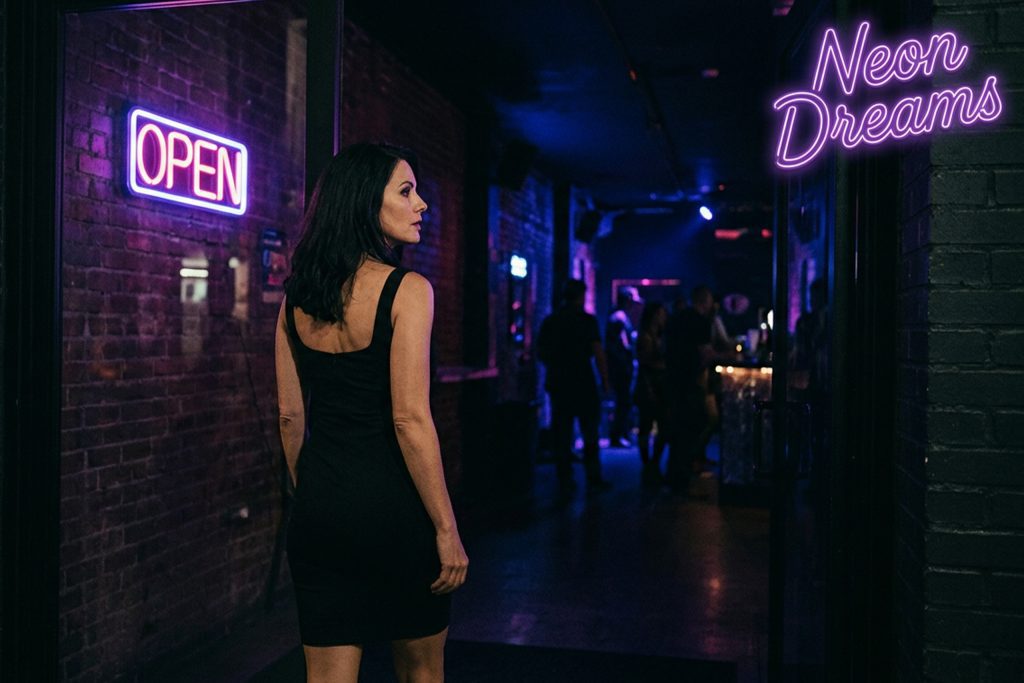
The bar didn’t have a name. It had a sign — a loop of neon tubing in the shape of the word OPEN, mounted above a door that looked like it had been salvaged from a shipping container. The neon had once been red, Kira guessed, but decades of neglect had bled the color out of it. Now it glowed the color of old blood, a dull arterial purple that flickered every few seconds like a failing heartbeat.
She found it in the space between coordinates — not quite the Red District, not quite the Industrial Zone. The kind of liminal place where people went when they didn’t want to be found.
She didn’t want to be found.
The door was heavy, manual, no auto-slide. She had to push it with her shoulder. Inside, the air was thick with something that might have been incense and might have been mold and might have been both. The lighting came from actual bulbs — glass, filament, electricity — not the ambient bioluminescence that followed you from room to room in the corporate sectors, adjusting its color temperature to your mood.
No one looked up when she entered. No AR tags appeared above anyone’s head. No one’s social credit score floated in her peripheral vision.
She was invisible. She was nobody. She was free.
The bartender set the glass in front of her and studied her face — the kind of look that came from organic eyes, not AR lenses. “You got that look,” the old woman said. “The one people get when they’re trying to remember who they are without someone telling them.”
Kira stared at it.
“First time off the grid?”
The voice came from her left. She turned.
The man sitting two stools down had silver hair — not gray, not white, but actual silver, the color of moonlight on metal. It fell across his forehead in a way that suggested he’d pushed it back recently and it had refused to stay. His eyes were gray, the color of the sky before a storm she’d seen once in a nature simulation. He was lean, angular, wearing a jacket that had been repaired too many times to be fashionable and too carefully to be careless.
And there was no AR overlay around him. No data tag. No information.
Just a man.
“You’re clean,” he said. Not a question.
Kira’s hand went to the spot behind her left ear — the phantom gesture, pressing the bruise that wasn’t there. “Just for tonight.”
“Tonight’s all we have.” He smiled, and it was the first genuine smile she’d seen in months. Not the algorithmically optimized expression people wore to improve their social credit scores — the precise upturn of lips calibrated for maximum approachability. Just a man showing teeth because something amused him. “I’m Jax.”
“Kira.”
“I know.”
Her shoulders tightened. The old reflex — being known meant being tracked, being tracked meant being managed, being managed meant being owned.
“Not because of data,” he said, holding up his hands. The palms were calloused, the fingers long and practical. Working hands. “Because you used to write for the Collective. Before they fired you for that piece on neural autonomy. The one that went viral.”
“You read that?”
“Everyone read that.” He slid a glass toward her — the same purple, the same smoke. “You pissed off some very important people.”
“Good.”
He laughed. The sound rough, unpracticed, a laugh that hadn’t been optimized for anything. “You’re braver than you look.”
“I look brave?”
“You look terrified.” He said it without judgment, the way someone might note the weather. “Which makes the bravery count more.”
Kira picked up the glass. The liquid was cold despite the smoke, and it tasted like blackberries and something metallic, like licking a battery. She coughed.
“First time drinking unregulated alcohol too,” Jax said. “The corporate stuff is calibrated for maximum enjoyment with minimum side effects. This will give you a hangover.”
“Good,” she said again, and meant it.
They talked for three hours.
Real conversation. No notifications interrupting their sentences. No AR translations smoothing the edges off their words. No autocorrect rewriting her thoughts into something more socially acceptable before they left her mouth. She said things that were awkward. She said things that were too honest. She said things she immediately wanted to take back.
Jax didn’t seem to mind. He answered her awkwardness with his own — pauses where he clearly edited himself, moments where he looked away and then looked back, sentences that started and stopped and started again. He was out of practice too. Not because he’d pulled his chips, but because he’d never had them.
“Never?” she said.
“Born off-grid. My mother didn’t believe in the system. My father didn’t believe in anything.” He shrugged, a movement that was too casual to be casual. “No birth registration. No identity number. No chips. I don’t exist.”
“How do you live?”
“Carefully.” He signaled the bartender for another round. “I move things. Information, mostly. Sometimes people.”
“Smuggling.”
“I prefer ‘independent logistics consultant.'” The smile again, quick and gone. “The corps don’t like things moving without their permission. People especially. There are communities out there — off-grid, unregistered, completely analog. People who’ve pulled their chips or never had them. I help them find each other.”
“Like me?”
“If you needed moving, sure.” His eyes met hers, and it landed in her chest — the weight of being looked at by someone who wasn’t running her through an algorithm. “But I think you need to stay still for a while. Figure out who you are without the chips.”
“And who am I?”
He leaned forward. Close enough that she could smell the ozone on his jacket, the particular scent of someone who spent time in the unregulated zones where the air still carried the residue of old electrical storms. Close enough that his breath warmed her cheek.
“Someone brave enough to pull her own chips,” he said. “That tells me everything.”
Kira looked away. Three seconds of eye contact. That was her limit. Any longer and he’d see something she wasn’t ready to show.
“Brave or stupid,” she said. “The line’s pretty thin.”
“The best lines are.”
The bar was emptying around them. The old woman with the mechanical fingers was wiping down the counter with a rag that left more residue than it removed. The neon sign outside flickered, died, flickered back to life. Kira felt the familiar hum of anxiety — she should go home, check her messages, plug back in before her credit score tanked, before the Collective flagged her as missing, before her apartment locked her out for biometric non-compliance.
But Jax’s hand was on the bar, palm up. An invitation.
She stared at it. A hand. Just a hand. Calloused, warm-looking, completely unoptimized.
She hadn’t touched another human being without the chips mediating the experience in six years. The social optimizer would have told her the exact pressure to apply, the exact duration, the exact moment to pull away for maximum rapport. Without it, she had no idea what to do.
She put her hand in his.
His palm was warm and rough and completely real. His fingers closed around hers — not the calibrated grip the chips would have recommended, just the pressure one human being applies to another when they want to hold on.
“Your chips are in your jacket,” he said quietly.
“I know.”
“You can plug back in whenever you want.”
“I know.”
“Do you want to?”
She looked at their hands. At the way his thumb was moving across her knuckles — not a pattern, not an algorithm, just movement. Just touch.
“No,” she said. “I don’t.”
The stairs to his apartment creaked. Not the simulated creak of a heritage building in the corporate sector — that carefully engineered sound designed to evoke nostalgia. Real creaking. Wood that had been wet and dried and wet again, fibers separating, nails loosening. The sound of decay. The sound of age.
The noodle shop below was closed for the night, but the smell of star anise and rendered pork fat still hung in the stairwell, thick enough to taste. Kira’s stomach growled. She couldn’t remember the last time she’d felt hunger — the biometric regulator had always managed her appetite, releasing ghrelin suppressants when she was busy, triggering satiety signals before she overate.
Now she was hungry. Now she was cold. Now she was aware of her body in a way that felt almost obscene.
The door at the top of the stairs had a manual lock. Jax produced a key — an actual key, metal, teeth cut into its edge — and worked it in the lock with a practiced twist. The door swung open.
“No cameras,” he said, stepping aside to let her enter. “No mics. No smart walls. No ambient anything. Just four walls and a roof and us.”
Kira stepped inside.
The apartment was small. Smaller than her efficiency unit, and her efficiency unit had been designed by people who thought 200 square feet was generous. A bed against one wall — narrow, unmade, the sheets twisted in a way that suggested restless sleep. A window that looked out onto the neon chaos of the lower levels. A table with two chairs. A hot plate. A shelf of actual paper books. A bag by the door, always packed.
The rain was louder here. The roof was corrugated metal, and every drop hit it like a tiny drum. The sound filled the room, made it feel fuller than it was.
“It’s not much,” Jax said.
“It’s the most real place I’ve ever been.”
He hung her jacket on a hook by the door. The chips were in the pocket. The jacket swung, and the distance between her and the chips grew from inches to feet to the width of a room.
“I don’t know how to do this,” she said.
“Do what?”
“Just us.” She turned to face him. “I don’t know how to be with someone without the chips. I don’t know what to say. I don’t know where to put my hands. I don’t know how to—” She stopped. The word she wanted was “want.” She couldn’t say it.
“Me neither,” Jax said.
She looked at him. Really looked. The silver hair was damp from the rain, darker at the temples. The gray eyes were steady on hers, but there was something behind them — a tension, a held breath. A smuggler, afraid.
“But I want to try,” he said.
The words landed in her chest and stayed there.
She kissed him first.
She hadn’t kissed anyone without AR guidance in years, and her aim was off. Her mouth landed somewhere near his chin — the stubble there was rough, uneven, nothing like the optimized skin textures of the men she’d dated in the corporate sector. She started to pull back, to apologize, to make a joke that would defuse the embarrassment.
Jax laughed. Not at her. With her. The sound warm and close and completely uncalibrated. Then his hand came up — calloused palm against her jaw, fingers spreading into her hair — and he adjusted, tilting her head until their mouths aligned.
“There,” he said against her lips. “Try again.”
She did.
The second kiss landed. His mouth was warm and tasted like the purple drink — sweet and metallic and strange. His lips were chapped, rough at the edges, and the sensation was so specific, so unpolished, that Kira felt something unlock in her chest. No algorithm was smoothing this. No pleasure optimizer was adjusting the pressure. This was just two mouths finding each other in the dark.
She made a sound. She didn’t mean to. It came out of her throat without permission — a small, surprised noise that was half gasp and half something she’d never heard herself make before.
Jax pulled back just far enough to look at her. “Okay?”
“I don’t know.” She was breathing harder than the kiss warranted. Her heart was doing something the biometric regulator would have corrected immediately. “I can’t tell if this is good or if I’m just not used to feeling anything.”
“Maybe both.”
“Maybe.”
He didn’t move. His hand was still on her jaw, his thumb resting against the corner of her mouth. He was waiting. Not pushing. Not optimizing. Just waiting.
Kira realized she had to decide. The chips had always decided for her — when to lean in, when to pull back, when to escalate, when to retreat. Without them, she had to choose. The terror of that was almost paralyzing.
She chose.
She put her hands on his chest. The fabric of his shirt was rough, woven from something natural — cotton, maybe, or hemp. She felt the heat of his body through it, and the heat was irregular, warmer near his sternum, cooler at his sides. No temperature regulation. Just a human body, radiating its own uneven warmth.
“I want—” she said, and stopped.
“What?”
“I don’t know how to say it.”
“Try.”
She closed her eyes. The rain was hammering the roof. The city was humming outside the window. Jax’s heart was beating under her palm — she felt it, a steady thump that was slightly too fast.
“I want you to touch me,” she said. “And I want to feel it. All of it. Even if it’s awkward. Even if I don’t know what to do. I want to be here for it.”
Jax exhaled. The sound rough, almost pained. “That’s the hottest thing anyone’s ever said to me.”
“It’s not supposed to be hot. It’s supposed to be honest.”
“Same thing.”
He kissed her again, and this time there was nothing tentative about it. His mouth opened against hers, and his tongue — warm, tasting of that strange metallic sweetness — slid along her lower lip, asking. She opened for him. The sensation was so specific, so unmediated, that it spread everywhere: the roof of her mouth, the base of her spine, the inside of her thighs.
His hands moved. One stayed in her hair, fingers tightening just enough to tilt her head back. The other found the hem of her shirt — a simple cotton thing she’d grabbed without thinking, nothing like the optimized fabrics that regulated her temperature and repelled moisture and adjusted their opacity based on ambient light. Just cloth. Just a barrier between his hand and her skin.
He didn’t push under it. He waited.
“Tell me,” he said, his mouth at her ear. His breath was hot and uneven. “What you want. Use your words.”
The question cracked something open in her. No one had ever asked her that. The chips had always known — had always read her biometrics and adjusted accordingly, optimizing her pleasure without ever requiring her to name it. She’d never had to say what she wanted. She’d never had to know.
“Your hands,” she said. The words came out rough, unpracticed. “On my skin. Under my shirt.”
He obeyed. His hand slid under the hem of her shirt, palm flat against her stomach. The contact jolted through her — his skin was warm and rough and damp from the rain, and her stomach muscles jumped under his touch like they’d been shocked.
“Cold?” he said.
“No. Just—” She couldn’t find the word. “Not used to it.”
“Not used to being touched?”
“Not used to feeling it.”
His hand moved higher. His palm traced the line of her ribs, one by one, the calloused skin catching on her own smoothness. The nano-moisturizers were still in her system — her skin was softer than it should be, more uniform. But she felt the difference between his texture and hers, and the contrast was so specific, so physical, that she forgot to be self-conscious.
“Your skin,” he said, his voice low. “It’s so—”
“Fake,” she said. “The moisturizers. They last for months even after you pull the chips.”
“I was going to say soft.”
“That’s the moisturizers.”
“Then I like the moisturizers.” His hand reached the band of her bra — plain cotton, unoptimized, bought at a street stall three hours ago when her smart fabric underwear had stopped working without the chips to power it. He paused there, his fingers resting on the elastic. “Can I?”
“Yes.”
He unhooked it with one hand — a practiced motion that made her wonder how many women he’d done this with, then made her decide she didn’t want to know. The bra loosened. His hand slid around to her back, palm spreading across her spine, pulling her closer.
She went. Her body against his, her breasts pressing into his chest through the thin cotton of her shirt, the heat of him bleeding through the fabric. She felt his heartbeat now — faster than before, matching hers.
“Your turn,” she said.
“My turn?”
“Your shirt. I want—” She stopped. The word “want” still felt dangerous in her mouth. “I want to feel you.”
He stepped back just far enough to pull his shirt over his head. The motion was efficient, unselfconscious — a man who didn’t think about his body as a performance. The shirt dropped to the floor.
Kira looked at him.
His chest was lean, the muscles defined but not sculpted — a body built by work, not by optimization. A scar ran across his ribs on the left side, a long pale line that spoke of something sharp and something painful and something survived. His skin was warmer in color than hers, and there was hair across his chest — dark, scattered, completely unmanaged.
She reached out and put her palm flat against his sternum. His skin was hot. Almost feverish. She felt the bone beneath the muscle, the steady pump of his heart, the slight vibration of his breath.
“You’re so warm,” she said.
“No temperature regulation.”
“I know. I just—” She spread her fingers, covering more of him. “I forgot what real body heat felt like.”
His hand came up and covered hers, pressing her palm harder against his chest. “Does it feel good?”
“Yes.”
“Then keep touching me.”
She did. Her hand moved up to his shoulder, down his arm, tracing the shape of him. The muscle was dense, functional. The skin was textured — a roughness here, a smoothness there, the raised line of the scar. She touched the scar with her fingertip, following its path across his ribs.
“Knife,” he said. “A job went bad. Three years ago.”
“Does it still hurt?”
“Only when I think about it.”
She leaned in and pressed her mouth to the scar. The skin there was smoother than the rest of him, cooler. His breath caught — a sharp inhale, his chest expanding under her lips.
“Kira.”
She looked up. His eyes were darker now, the gray gone almost black. His jaw was tight.
“What?”
“That’s the first time you’ve touched me without me asking first.”
She hadn’t realized. The observation landed in her chest and spread — warmth, surprise, something that might have been pride. She’d initiated. She’d wanted something and reached for it.
“Was it okay?”
“It was—” He stopped. Swallowed. “Yeah. It was okay.”
She kissed the scar again. Then higher, the center of his chest. Then his collarbone, where the skin was thin and the bone was close to the surface. She could taste salt — sweat, rain, the particular flavor of his skin. No optimized pheromones. No engineered chemistry. Just a man, tasting like a man.
His hands found the hem of her shirt. “Can I?”
“Yes.”
He pulled it up slowly — not the efficient strip of someone trying to get to the destination, but the deliberate unveiling of someone who wanted to see the journey. The fabric cleared her stomach, her ribs, her breasts. He paused there, the shirt bunched under her arms, and looked at her.
“You’re beautiful,” he said.
“The moisturizers—”
“Kira.” His voice firm. “I don’t care about the moisturizers. I care about you. Standing here. Letting me see you. That’s what’s beautiful.”
She didn’t believe him. But she wanted to. And wanting to believe was a start.
She raised her arms and let him pull the shirt the rest of the way off. It joined his on the floor. Her bra was already loose, and she let it fall — shrugged it off her shoulders, let it drop.
She stood there, bare from the waist up, in a stranger’s apartment above a noodle shop, with rain hammering the roof and neon light painting stripes across her skin. She’d never felt more exposed. She’d never felt more real.
Jax didn’t touch her immediately. He looked. His eyes moved across her body — her breasts, her stomach, the curve of her waist — with an attention that felt almost physical. She felt his gaze like pressure, like heat.
“You’re staring,” she said.
“I’m memorizing.”
“Why?”
“Because no one’s ever looked at you without a data layer between them.” His voice rough. “Someone should. Someone should see you exactly as you are.”
The words hit her in a place she’d been protecting for years. Her eyes burned. She blinked hard, refused to cry. Crying was vulnerability. Vulnerability was danger.
“Your turn,” she said, to change the subject, to deflect, to hide.
“My turn for what?”
“To be looked at.”
He understood. His hands went to his belt — manual buckle, actual leather — and worked it open. His pants were simple, functional, the fabric worn soft at the knees. He pushed them down, stepped out of them, stood before her in nothing but a pair of cotton briefs that had been washed too many times.
His legs were long and lean, the muscles defined from walking, running, climbing. More scars — a small one on his knee, another on his thigh. His body was a record of his life, every mark a story.
Kira looked at him the way he’d looked at her. Slowly. Deliberately. Letting her eyes travel.
“You’re doing it too,” he said.
“Doing what?”
“Memorizing.”
“Someone should,” she said, throwing his words back at him. “Someone should see you exactly as you are.”
Something shifted in his expression. The confidence cracked. Underneath it was something rawer — uncertainty, maybe, or hope. A man who’d spent his life being useful to others, never letting anyone be useful to him.
“Your pants,” he said, his voice rougher than before. “Can I?”
She nodded.
He knelt.
The sight of him on his knees in front of her — this man who checked exits, who never stayed anywhere long, who converted every emotion into a practical action — undid something in her chest. He wasn’t being practical now. He was kneeling on the floor of his temporary apartment, his hands at the waist of her pants, looking up at her with those gray eyes that had gone dark.
He unbuttoned her pants. The fastener was manual — she’d bought these too at the street stall, cheap cotton things that didn’t require chip authentication to remove. He worked the button free, pulled the zipper down. The sound of it was loud in the quiet room, louder than the rain.
He peeled the pants down her hips, her thighs, her calves. She stepped out of them. He stayed on his knees for a moment longer, his hands resting on her hip bones, his thumbs tracing the hollows there.
“I don’t usually do this,” he said.
“Do what?”
“Stay in one place.” He looked up at her. “Kneel. Wait. Let someone else set the pace.”
“Is it hard?”
“Terrifying.”
She reached down and put her hand on his face. Her palm against his jaw, her fingers in his silver hair. The gesture felt foreign — she was comforting him. She was the one in control. She was the one who could hurt him or save him.
“Get up,” she said softly.
He rose. They stood facing each other, both nearly bare, the narrow bed behind them, the rain above them, the city around them. The moment stretched.
“I don’t know what happens next,” Kira said.
“Neither do I.”
“Is that okay?”
“I think it has to be.”
She reached behind her back and unhooked her underwear — plain cotton, the last barrier. Let it fall. Stepped out of it.
Jax’s breath caught. His eyes moved down her body and back up, and his hands — those calloused, practical hands — hung at his sides, waiting.
“Your turn,” she said.
He pushed his briefs down and stepped out of them.
They stood naked in the neon light.
Kira looked at him — all of him. His cock was hard, curving up toward his stomach, the head dark with blood. The sight of it — so specific, so physical, so unmediated — sent a pulse of heat through her throat, her chest, between her legs.
“You’re staring,” he said.
“I’m memorizing.”
He laughed — that rough, unpracticed sound. Then he stepped forward, closing the distance between them, and put his hands on her waist. His palms were hot and dry and rough, and the contact made her stomach muscles jump.
“Bed?” he said.
“Bed.”
The bed was narrow — a single, maybe a double if they pressed close. The sheets were cotton, worn soft, smelling of him. The mattress was thin, and when Kira lay down on it, she felt the slats beneath, the give of old wood.
Jax lay beside her. The bed forced them together — there wasn’t room to be separate. His body was a line of heat along her side, his hip against hers, his shoulder pressing into her shoulder.
“Not a lot of room,” he said.
“Good.”
“Yeah?”
“I don’t want room.” She turned on her side to face him, and the movement brought their bodies into full contact — chest to chest, hip to hip, thigh to thigh. His cock pressed against her stomach, hot and hard, and her own body answered — a clench, a pulse, a spreading slick between her legs she hadn’t felt in years without the pleasure optimizer triggering it.
“Tell me what you want,” he said again.
She was starting to understand why he kept asking. It wasn’t just consent. It was an invitation. Every time he asked, he was giving her permission to want something. And every time she answered, she was learning how.
“Your hands,” she said. “Everywhere. Slowly.”
He started at her shoulders. His palms spread across her collarbones, his thumbs tracing the ridges of bone beneath skin. The pressure was light — barely there, a suggestion of touch. Then firmer, his hands sliding down to her breasts.
He cupped them. Not grabbing, not demanding. Just holding. His palms were warm and rough against the softness, and when his thumbs found her nipples — already hard, already aching — she made a sound she couldn’t control.
“There?” he said.
“Yes.”
He circled her nipples with his thumbs, slow at first, then faster. The sensation was so specific — the texture of his calloused skin against the sensitive peaks, the pressure changing from light to firm and back again — that it spread everywhere. Her clit throbbed in sympathy. Her hips moved without her permission, pressing against his thigh.
“More,” she said. The word came out before she could stop it.
“More what?”
“Your mouth. On me. Here.” She touched her own breast, showing him where.
He lowered his head. His mouth found her nipple — the left one first, the one closest to him — and his tongue was hot and wet and completely unprogrammed. He licked her in a way no algorithm would have recommended: too slow, then too fast, then a pause, then a suck that made her back arch off the mattress.
“Good?” he said against her skin.
“Don’t stop.”
He didn’t. He moved to her other breast, gave it the same attention — the same unpredictable rhythm, the same heat, the same wet heat. His hand replaced his mouth on the first breast, fingers rolling her nipple, and the dual sensation — wet heat on one side, rough warmth on the other — made her dizzy.
She reached for him. Her hand found his cock — she wanted to touch him, wanted to give back what he was giving her. Her fingers wrapped around his shaft, and the sensation was startling: hot, smooth skin over hardness, the weight of him in her palm, the pulse she felt beating under her thumb.
Jax groaned. The sound low and rough and purely involuntary, and it vibrated against her breast where his mouth was still working.
“Kira.” His voice strained. “If you do that—”
“What?”
“I’m not going to last.”
“Then don’t last.”
He lifted his head and looked at her. His eyes were dark, his lips wet, his breathing ragged. “Not yet. Not before you.”
“Before me what?”
“Before you come.”
The word landed in her stomach. Come. She hadn’t come without the pleasure optimizer in years. She wasn’t sure she could. The chip had always managed it — the precise sequence of stimulation, the exact timing, the biometric feedback loop that adjusted every touch in real time until orgasm was inevitable. Without it, she was flying blind.
“I don’t know if I can,” she said.
“Can what?”
“Come. Without the chips. I don’t know if my body knows how.”
Jax’s expression changed. The desire was still there, but something else joined it — tenderness, maybe, or determination. “Then we’ll find out.”
His hand moved down her body. Over her ribs, her stomach, the curve of her hip. His fingers traced the line where her thigh met her body, back and forth, light and then firmer, until she was squirming.
“Open your legs,” he said.
She did.
His hand found her pussy. His palm cupped her there, just holding, not moving. The heat of his hand against her heat. The pressure of his palm against her clit through the outer lips. She was wet — she felt it, the slickness spreading, the way his hand slid when he adjusted.
“You’re soaked,” he said. His voice rough with something that might have been awe.
“Is that good?”
“It’s—” He shook his head. “Yeah. It’s good.”
His fingers moved. He parted her outer lips, found the inner ones, traced them with a fingertip. The touch was light, exploratory, learning her shape. Every millimeter registered — the texture of his calloused skin against her most sensitive flesh, the way he paused at her entrance and then moved higher, the sharp jolt when his finger brushed her clit.
She gasped. Her hips jerked.
“There,” he said. Not a question.
“Yes. There. Again.”
He circled her clit with one finger. Slow. Too slow. The sensation built in layers — the direct touch, the indirect pressure, the way her whole body was tightening toward something she couldn’t name. His finger moved faster, then slower, then stopped entirely.
“Why did you stop?”
“Because I want to taste you.”
The words went through her like a current. No one had ever said that to her. The chip-mediated encounters had been efficient — penetration, optimization, orgasm, done. Oral sex had been a checkbox, a step in the algorithm, never something a partner wanted for its own sake.
“You don’t have to—”
“I want to.” He was already moving down her body, his mouth tracing a path along her ribs, her stomach, the jut of her hip bone. “I want to know what you taste like without the chips telling me it’s optimized.”
He settled between her legs. His shoulders pushed her thighs wider — the stretch of it, the exposure, the vulnerability of being this open to someone. The neon light from the window painted stripes across his silver hair, across her stomach, across the bed.
His mouth found her.
His tongue was hot and wet and nothing like the precision instruments the chips had guided. He licked her in broad strokes at first — the whole length of her, from entrance to clit — and the sensation was so overwhelming that she made a sound she’d never made before. A cry. A moan. Something that came from her chest and her throat and her cunt all at once.
“Okay?” he said, lifting his mouth just far enough to speak.
“Don’t stop. Please don’t stop.”
He didn’t. His tongue found her clit and stayed there, circling, flicking, pressing. The rhythm was unpredictable — fast, then slow, then a pause where he just held his mouth against her, breathing heat onto her most sensitive place. His fingers joined in — one sliding inside her, then two, curling forward to find a spot that made her see light behind her closed eyes.
She was climbing toward something. Her body was tightening, her breath was coming in gasps, her hands were fisted in the sheets. The pleasure was building in a way that felt dangerous — like she might break apart, like she might not survive it.
“I’m—” she said, and couldn’t finish.
“Close?”
“I don’t know. Maybe. Something’s—”
“Let it happen.”
“I can’t—”
“You can.” His mouth was on her again, his fingers moving inside her, his other hand pressing flat on her stomach to feel the muscles clenching. “Let go, Kira. I’ve got you.”
The words broke something. Let go. I’ve got you. No one had ever said that to her. No one had ever offered to catch her.
She let go.
The orgasm took her apart — not the controlled, optimized release the chip used to deliver, but something wild and unmanaged and terrifying. Her back arched off the bed. Her thighs clamped around his head. A sound came out of her that was half scream and half sob, and her hands found his hair and pulled, and her cunt pulsed around his fingers in rhythmic clenches that went on and on.
She came apart. She came back together.
When she could breathe again, Jax was beside her, his face level with hers, his expression open and unguarded in a way she hadn’t seen before.
“There you are,” he said.
“What?”
“You were here. The whole time. You didn’t go anywhere.”
She hadn’t. She’d stayed in her body. She’d felt every second of it — the buildup, the peak, the long slow slide down. She hadn’t dissociated. She hadn’t observed from the control room. She’d been present.
“I came,” she said, and the words felt like a discovery.
“You did.”
“Without the chips.”
“Yeah.”
She started to cry.
It wasn’t the controlled crying the biometric regulator used to permit — a brief release of tension, neatly contained. This was ugly crying. Her face crumpled. Her breath hitched. Tears ran down her cheeks and into her ears and onto the pillow.
Jax didn’t tell her to stop. He didn’t tell her it was okay. He just pulled her against his chest and held her, one hand in her hair, one hand on her back, his heartbeat steady under her ear.
She cried until she was empty. Then she lay there, her face pressed into his chest, her body still shaking with aftershocks.
“I’m sorry,” she said.
“For what?”
“For crying. For—” She didn’t know how to finish.
“For being human?”
The words landed. She’d been trying not to be human for so long. The chips had promised to make her better than human — optimized, efficient, socially calibrated. But better than human meant less than human. And less than human meant alone.
“I don’t know how to do this,” she said again.
“Do what?”
“Be human. Feel things. Stay present.”
“Me neither.” His hand was moving on her back, slow circles. “But I think the only way to learn is to do it.”
She lifted her head and looked at him. His gray eyes were steady on hers, and she held the eye contact for longer than three seconds. Four. Five. Six.
She didn’t look away.
“I want to make you feel good,” she said. “The way you made me feel good.”
“You don’t have to—”
“I want to.” She put her hand on his chest, over his heart. “Tell me what you want. Use your words.”
He exhaled. The sound shaky. “No one’s ever asked me that.”
“Then I’m asking now.”
He was quiet for a moment. His hand on her back had stopped moving. She felt him thinking — the tension in his muscles, the slight acceleration of his heartbeat.
“Your mouth,” he said finally. “On me. If you want to.”
“I want to.”
She moved down his body the way he’d moved down hers. She kissed his chest, his stomach, the scar across his ribs. She tasted salt and skin and the particular flavor of him — something clean, something male, something completely unengineered.
His cock was hard against his stomach, the head dark and slick with pre-cum. She wrapped her hand around the base of it — the skin was hot and smooth and the weight of it in her palm made something clench low in her belly.
She lowered her mouth.
The taste of him was salt and skin and something slightly bitter — pre-cum, the first time she’d ever tasted it without the chips filtering the sensory input. She licked the head, circling her tongue around the ridge, and Jax made a sound that was almost pained.
“Good?” she said.
“Jesus, Kira.”
She took him deeper. Her mouth stretched around his thickness, her tongue pressing against the underside of his shaft. She moved slowly — learning the shape of him, the weight, the way his hips twitched when she sucked harder. Her hand worked the base of him in rhythm with her mouth, and she felt him getting harder, thicker, the pulse under her tongue accelerating.
“Kira.” His voice strained. “If you keep—I’m going to—”
She looked up at him without lifting her mouth. His eyes were on her, dark and desperate, his jaw tight, his hands fisted in the sheets.
She kept going.
He came with a groan that sounded torn out of him. His hips jerked, his cock pulsed against her tongue, and the taste of him filled her mouth — salt and heat and something that was purely him. She swallowed, kept her mouth on him through the pulses, felt him soften gradually against her tongue.
When she finally lifted her head, he was staring at the ceiling, his chest heaving, his hands still gripping the sheets.
“Kira.”
“Yes?”
“I don’t—” He stopped. Swallowed. “I don’t know what to say.”
“You don’t have to say anything.”
She crawled back up the bed and settled against his side. His arm came around her automatically, pulling her close. Their bodies were sticky with sweat, the sheets were twisted, the rain was still hammering the roof.
She felt good. She felt real. She felt present.
Terror washed through her.
Because this — this connection, this presence, this being seen — was exactly what she’d been running from her whole life. And now she was in it. And she didn’t want to leave.
Jax’s breathing slowed. His hand on her back resumed its slow circles. He might be falling asleep.
Then he spoke.
“We should get some rest.”
The words were practical. Reasonable. And they landed in her chest like a door closing.
We should. Not I want. Not stay with me. A practical action. The conversion of emotion into task.
Kira felt the distance open between them — inches on the narrow bed, miles in every other way. He was still holding her. But something had shifted. The man who’d been present, vulnerable, open — he was retreating. She felt it in the way his hand had stopped moving on her back. In the way his breathing had become controlled, deliberate.
“Jax.”
“Yeah?”
“Where did you just go?”
“Nowhere. I’m right here.”
“No.” She lifted her head and looked at him. “You were here. And then you went somewhere. Where?”
His jaw tightened. The gray eyes flicked away from hers — the first time he’d broken eye contact all night.
“I don’t know what you mean.”
“You do.”
He was quiet for a long moment. The rain filled the silence. The neon sign outside the window flickered, died, flickered back.
“I’m not good at this,” he said finally.
“At what?”
“Staying.” The word came out rough, like it had edges. “After. I’m good at the before. I’m good at the during. I’m not good at the after.”
“Why?”
He didn’t answer. His hand had left her back now. He was staring at the ceiling, and she could see the muscles in his jaw working.
“Jax.”
“I don’t talk about it.”
“About what?”
“My past. Why I am the way I am.” He turned his head and looked at her, and his eyes were guarded now — the smuggler again, the man who checked exits. “You haven’t talked about yours either.”
The words were a deflection. She recognized it because she did the same thing. Turn the question back on the asker. Make it about them instead of you.
“Fair,” she said. “So I’ll go first.”
He blinked. “What?”
“You said you don’t share until the other person shares first. So I’ll go first.”
“Kira, you don’t have to—”
“I was fourteen.” She said it fast, before she could stop herself. “When I got my first chip. The social optimizer. My mother took me to the clinic. She said, ‘Now you’ll finally know how to be around people.'”
Jax was watching her. His expression had shifted — the guard was still up, but something behind it was listening.
“I didn’t have friends,” she said. “I was awkward. I said the wrong things. I didn’t know how to read people. The chip was supposed to fix me. And it did. After the implant, I knew exactly what to say. Exactly how to stand. Exactly when to smile. People liked me.”
“But?”
“But it wasn’t me they liked. It was the chip. The algorithm. The optimized version.” She touched the spot behind her ear — the phantom gesture. “I’ve been performing for thirteen years. And I don’t know who I am without the performance.”
The words hung in the air. She’d never said them out loud. She’d never even thought them this clearly.
“That article,” Jax said. “The one that got you fired.”
“It was the first real thing I ever wrote. The first thing that wasn’t optimized for engagement metrics. I wrote about what the chips take from us. What we give up when we let algorithms manage our personalities. I wrote about the silence in my own head — the space where my real self used to be.”
“And they fired you.”
“The day it went viral. They said I’d violated the Collective’s content standards. But what I’d really violated was the illusion that the chips make us better.”
Jax was quiet. His hand found hers on the bed — not holding, just touching. His fingers against her fingers.
“That’s why you pulled them,” he said.
“That’s why I pulled them. Because I’d rather be a real nobody than an optimized somebody.”
He exhaled. The sound long and slow, like he’d been holding his breath.
“My turn,” he said.
“You don’t have to.”
“You did.”
She waited.
“I was nineteen.” His voice different now — lower, rougher, the words coming slower. “I was smuggling a woman out of the corporate zones. Her name was Elara. She was a data engineer who’d found evidence of illegal surveillance — the corps were monitoring people without consent, selling the data to the highest bidder. She was going to go public. They were going to kill her.”
“What happened?”
“I got her out. Took her through the unregulated zones, across three territories, to a community in the old district. It took two weeks. By the end of it—” He stopped. Swallowed. “By the end of it, I was in love with her.”
Kira didn’t move. Didn’t speak.
“I stayed. For three months. The longest I’d ever stayed anywhere. I thought—” He shook his head. “I thought I’d found something. Someone. A reason to stop running.”
“What happened?”
“One morning she was gone. Left a note. It said: ‘You’re a good man, Jax, but you’re not a man who stays. I need someone who stays.'”
The words landed in Kira’s chest like stones.
“So you left,” she said.
“I left before she could come back. Before she could change her mind. Before I had to find out if she meant it.” His jaw was tight. “I’ve been leaving ever since.”
“That was thirteen years ago.”
“Yeah.”
“And you’ve never stayed anywhere since?”
“I stay long enough to help. Then I move on. It’s easier.”
“Easier than what?”
“Easier than being left.”
Kira turned on her side to face him. The narrow bed forced them close — her hip against his, her hand on his chest.
“You’re not free,” she said.
“What?”
“You think you’re free because you’re not chipped. Because you’re off-grid. Because you don’t answer to anyone. But you’re not free. You’re running. And running isn’t the same as being free.”
His eyes met hers. The gray was stormy now, turbulent. “What’s the difference?”
“Freedom is choosing to stay. Running is being afraid to.”
He didn’t answer. But his hand came up and covered hers on his chest. His fingers laced through hers and held on.
“I’m afraid too,” she said. “Of being seen. Of being known. Of finding out that the real me isn’t enough. But I’m here. I’m not running. I’m staying.”
“Why?”
“Because you saw me. Tonight. You looked at me without any data between us, and you didn’t look away. No one’s ever done that.”
“I didn’t look away because there was nothing to look away from.”
“That’s not true. There’s plenty to look away from. I’m a mess. I’m terrified. I don’t know who I am. I cried after sex.”
“You cried because you felt something real for the first time in years. That’s not a mess. That’s being alive.”
She stared at him. The words were so simple. So true. She’d been so afraid of being a mess that she’d forgotten messes were what humans were made of.
“Stay,” she said.
The word hung in the air. It hit him — the flinch, the tension in his jaw, the way his hand tightened on hers.
“I don’t—”
“I know. You don’t stay. You never stay. But I’m asking you to. Not forever. Just tonight. Just tomorrow. Just long enough to find out what happens if you don’t run.”
He was quiet for a long time. The rain had softened — the storm was passing, the drops now a gentle patter instead of a hammering. The neon sign outside flickered and held steady.
“I don’t know how,” he said finally.
“How to stay?”
“How to let someone need me. How to need someone back. How to—” He stopped. His voice dropped. “How to be the man who stays.”
“Neither do I. I don’t know how to be the woman who doesn’t run. I don’t know how to let someone see me. I don’t know how to want things and say them out loud.” She squeezed his hand. “But I did it tonight. All of it. With you. And I survived.”
“You more than survived.”
“What?”
“You came alive. I watched it happen. You walked into that bar like a ghost. You’re not a ghost anymore.”
She kissed him. Soft, this time. A kiss that wasn’t about desire — it was about gratitude. About recognition. About two people seeing each other clearly for the first time.
When she pulled back, his eyes were wet. Not crying — not quite. But close.
“I want to try,” he said. “Staying. I want to try.”
“That’s all I’m asking.”
He pulled her against him. Not for sex — for holding. His arms wrapped around her, his face pressed into her hair, his body a line of heat along her whole length. His breath slowed. The tension in his muscles released, increment by increment.
They lay like that for a long time. The rain stopped. The city hummed its neon song outside the window. The sign flickered and held.
Kira fell asleep in his arms.
She woke to gray light and the smell of frying noodles.
The window was pale with morning — the diffuse glow of a city that never saw direct sunlight, the upper levels blocking the sky for everyone below. The rain had stopped. The neon sign outside was dark now, just a loop of glass tubing waiting for night.
Jax was still beside her. Still holding her.
He’d stayed.
She turned her head and found him awake, propped on one elbow, watching her. His silver hair was a mess, his eyes were soft with sleep, and his expression was something she couldn’t read — open, unguarded, uncertain.
“You stayed,” she said.
“I stayed.”
“How do you feel?”
“Terrified.” He smiled — that rough, unpracticed smile. “And good. Both. At the same time.”
“That’s how I feel too.”
“Your chips are in your jacket,” he said quietly. “You can plug back in whenever you want.”
“I don’t want.”
“You will. Eventually. The world’s not built for unplugged people. You’ll need to work, to travel, to interface with systems that don’t recognize you without your identity chip.”
“Then I’ll build a new world.” She sat up, pulling the sheet around her. The cotton was rough against her skin, and she felt every thread. “Or I’ll find the people who already have.”
Jax’s expression shifted. Something sparked in his eyes — recognition, maybe, or hope.
“There’s a community,” he said. “In the old district. About two hundred people. All off-grid. All unregistered. Some pulled their chips, some never had them. They’ve built something — a real place, with real walls and real food and real connections. No data. No optimization. Just people.”
“Show me.”
“I will.” He leaned in and kissed her — soft, slow, a promise. “But first, breakfast. And then maybe—” He stopped.
“Maybe what?”
“Maybe we do this again.”
“This?”
“Wake up together. In the same place. Without either of us running.”
Kira felt the words settle in her chest. A possibility. A door opening. A future that wasn’t guaranteed but was at least imaginable.
“I’d like that,” she said.
“Yeah?”
“Yeah.”
He kissed her again. Longer this time. Deeper. His hand found her waist under the sheet, palm warm against her skin — real body heat, unregulated, completely his.
When he pulled back, his eyes had changed. The softness was still there, but something else had joined it — hunger, maybe, or relief. The look of a man who’d been running for thirteen years and had just realized he could stop.
“Kira.”
“What?”
“I want—” He stopped. Swallowed. “I want you. Again. Now. If you want.”
She did want. The heat was building between her legs, the tightness in her chest, the way her body was already leaning toward his. But this time was different. This time she wasn’t uncertain. This time certainty moved through her like water.
“I want,” she said. “But this time—”
“What?”
“This time I’m in charge.”
His eyes widened. Then something shifted in his expression — surprise, then understanding, then something that looked like relief.
“Okay,” he said.
“Okay?”
“Yeah. Okay.”
She pushed him onto his back. The movement was gentle but firm — her hand on his chest, guiding him down. He went willingly, his silver hair spreading across the pillow, his gray eyes fixed on hers.
“You’ve been taking care of people your whole life,” she said. “Smuggling them. Protecting them. Making them feel safe.”
“Yeah.”
“Who takes care of you?”
The question landed. It hit him — the slight flinch, the way his jaw tightened, the way his eyes flicked away and then back.
“No one,” he said.
“Then let me.”
She straddled him. Her thighs spread across his hips, her knees pressing into the mattress on either side of his body. She was still naked from the night before, and the feeling of her bare skin against his — her slick heat against his stomach, her breasts hanging above his chest — sent a current through her.
He reached for her. His hands found her thighs, palms spreading across the muscle there.
“No,” she said.
“No?”
“You don’t touch me until I tell you to. You don’t move until I tell you to. You’ve been in charge of everything for thirteen years. For the next hour, you’re not in charge of anything.”
His breath caught. His hands dropped to the mattress, palms up, open. Surrendering.
“Okay,” he said. His voice rough. “I can do that.”
“Can you?”
“I want to try.”
She leaned down and kissed him. Not soft this time — hungry. Her mouth opened against his, her tongue sliding past his lips, claiming. His body answered — his cock hardening against her thigh, his breath accelerating, his hands twitching on the mattress like they wanted to grab her.
She pulled back. “You’re already fighting it.”
“Fighting what?”
“The urge to take over. To lead. To be in control.”
“I’m not—”
“Your hands.” She nodded at them. “They’re gripping the sheets.”
He looked down at his own hands like they’d betrayed him. Slowly, deliberately, he relaxed them.
“Sorry.”
“Don’t be sorry. Just let me.”
She kissed his neck. The tendon that ran from his jaw to his collarbone — she traced it with her tongue, felt his pulse jumping under her mouth. She kissed his chest, the scar across his ribs, the flat plane of his stomach. She moved down his body slowly, deliberately, taking her time.
His cock was hard against his belly, the head slick with pre-cum. She wrapped her hand around the base — the skin was hot, the pulse strong under her fingers.
“Kira.” His voice strained.
“Shh.”
She lowered her mouth. She took him in slowly — the head first, her tongue circling the ridge, tasting salt and skin and the particular bitterness of him. Then deeper, her lips stretching around his thickness, her throat relaxing to take more of him.
He groaned. The sound low and rough and purely involuntary, and his hips twitched — an aborted thrust, immediately controlled.
“Good,” she said, lifting her mouth just enough to speak. “You’re learning.”
She took him deeper. Her mouth worked him in a rhythm she set — slow, then fast, then a pause where she just held him in her throat and breathed. Her hand worked the base of him in counterpoint, twisting on the upstroke. She felt him getting closer — the tension in his thighs, the way his breathing had gone ragged, the pulse under her tongue accelerating.
She stopped.
“Kira—” His voice desperate.
“Not yet.”
She crawled back up his body. She positioned herself above him — her knees on either side of his hips, her pussy hovering just above his cock. She was wet — she felt it, the slickness spreading down her inner thighs. She reached down and took him in her hand, guided the head of his cock to her entrance.
“Look at me,” she said.
He did. His gray eyes were dark, desperate, open in a way she hadn’t seen before. No guard. No distance. Just a man who wanted her and was letting her see it.
She sank down onto him.
The sensation was overwhelming — the stretch of her pussy around his thickness, the heat of him filling her, the way her body resisted and then relented. She took him inch by inch, controlling the pace, controlling the depth, feeling every millimeter of him inside her.
“Jesus.” His voice strained. “Kira.”
She started to move. Slow at first — a roll of her hips, a lift and a sink. She found a rhythm that worked for her, that hit the places inside her that wanted to be hit. Her clit rubbed against his pubic bone on every downstroke, and the dual sensation — the fullness inside, the friction outside — built in layers.
She rode him. She controlled everything — the speed, the depth, the angle. When she wanted it faster, she moved faster. When she wanted it deeper, she sank down harder. When she wanted to pause and just feel him inside her, she paused.
Jax lay beneath her, his hands still at his sides, his eyes fixed on her face. He was letting her lead. He was letting her take. He was surrendering control, and she could see what it was costing him — the tension in his jaw, the way his hands kept twitching toward her and then stopping.
“You can touch me now,” she said.
His hands found her immediately. One on her hip, one on her breast — not grabbing, not controlling, just holding. His thumb found her nipple and circled it, and the added sensation made her gasp.
“More,” she said. “Your other hand. On my clit.”
He obeyed. His hand slid down her stomach, his fingers finding her clit where it was pressed against his body. He circled it in rhythm with her movements, and the combination — his cock inside her, his fingers on her clit, his other hand on her breast — sent her spiraling toward the edge.
“I’m close,” she said.
“Me too.”
“Wait for me.”
“I will.”
She rode him harder. Her hips moved faster, her breath came in gasps, her thighs burned with the effort. The pleasure was building — a pressure deep in her pussy, a tightening in her stomach, a heat that was spreading through her whole body.
“Now,” she said. “Come with me. Now.”
She let go.
The orgasm broke over her — bigger than the night before, deeper, more complete. Her pussy clenched around his cock in rhythmic pulses, her back arched, her head fell back, and a sound came out of her that was half his name and half something wordless.
He came at the same moment — his cock pulsing inside her, his hips jerking up into her, his groan rough and broken. His hands gripped her hips hard enough to leave marks, and the heat of his cum flooded her, filled her.
She collapsed onto his chest. Her body was shaking, her breath was ragged, her heart was pounding so hard she felt it in her throat.
They lay there, tangled and sweaty and breathing in sync. The morning light was getting stronger, the city was waking up outside, the smell of noodles from below was getting thicker.
Jax’s arms came around her. His hands spread across her back, holding her against him.
“Kira.”
“Mm.”
“That was—” He stopped. “I don’t have words.”
“Then don’t use words.”
She lifted her head and looked at him. His face was open, unguarded, transformed. The man who checked exits wasn’t checking exits. The man who never stayed was still here.
“You let me lead,” she said.
“Yeah.”
“Was it hard?”
“Hardest thing I’ve ever done.” He smiled — that rough, unpracticed smile. “And the best.”
“Why?”
“Because—” He stopped. Swallowed. “Because I’ve never let anyone take care of me before. I’ve never let anyone be in charge. I’ve never—” He shook his head. “I’ve never let myself need someone.”
“And now?”
“Now I need you.” The words came out rough, like they had edges. “And I’m not running.”
She kissed him. Soft, slow, a kiss that was a promise and a question and an answer all at once.
“I need you too,” she said against his mouth. “And I’m not running either.”
Outside, Neo-Shanghai hummed its neon song. The noodle shop below was opening for the day — she could hear the clatter of pots, the sizzle of oil, the murmur of early customers. The neon sign above the bar down the street was dark now, waiting for night to give it purpose again.
Kira lay in Jax’s arms in the narrow bed above the noodle shop, and for the first time in thirteen years, she understood herself.
Not a journalist. Not a former employee of the Collective. Not a woman defined by her chips or her credit score or her social optimization metrics.
Just Kira. Just herself. Just present.
“We should eat,” Jax said.
She laughed. “There it is.”
“There what is?”
“The practical thing. The conversion of emotion into task.”
He had the grace to look sheepish. “Old habits.”
“I know.” She sat up, pulling the sheet around her. “But this time, the practical thing is actually practical. I’m starving.”
“The noodles here are incredible. The owner — Mrs. Chen, no relation — makes them by hand. No synthesizer. No optimized nutrition profile. Just flour and water and pork broth that’s been simmering for three days.”
“Sounds perfect.”
They dressed slowly, in the gray morning light. Kira put on her street-stall clothes — the plain cotton shirt, the simple pants, the underwear that didn’t require chip authentication. Her jacket was still on the hook by the door, the chips still in the pocket.
She didn’t touch them.
Jax pulled on his worn pants, his repaired jacket. He checked the window — not checking exits, just looking at the day. Then he turned to her.
“There’s something I want to show you,” he said. “After breakfast.”
“What?”
“The community. The one in the old district. It’s about an hour’s walk from here, through the unregulated zones. I can take you there. Introduce you. If you want.”
“To stay?”
“To visit. To see if it fits.” He stepped closer, put his hands on her shoulders. “I’m not asking you to move there. I’m not asking you to commit to anything. I’m just asking you to come see it. With me.”
“And after?”
“After, we figure it out. Together. Whatever that looks like.”
Kira looked at him — this man with silver hair and gray eyes and calloused hands, who’d spent thirteen years running and had just spent one night staying. He wasn’t promising forever. He wasn’t promising anything except presence. And presence, she was learning, was enough.
“Okay,” she said.
“Okay?”
“Let’s go see it. After breakfast.”
He smiled. That rough, unpracticed smile that she was starting to love.
They walked down the creaking stairs together, into the smell of star anise and pork broth, into the gray morning of a city that didn’t know they existed. Two unregistered people. Two unoptimized bodies. Two humans who had found each other in the space between coordinates.
The noodle shop was warm and steamy and full of people who didn’t have AR tags floating above their heads. Mrs. Chen — an old woman with flour on her apron and a face that had never seen a nano-moisturizer — brought them two bowls of noodles without asking what they wanted. She just looked at them and knew.
Kira ate. The broth was rich and salty and burned her tongue. The noodles were chewy and irregular — handmade, imperfect, real. She ate the whole bowl. She was full.
“Ready?” Jax said.
“Ready.”
They stepped out into the street. The rain had washed the city clean — or as clean as the lower levels ever got. The neon signs were dark, the streets were wet, the air smelled like ozone and cooking oil and possibility.
Jax took her hand. Not because an algorithm told him to. Not because it was optimized for rapport. Just because he wanted to.
She held on.
They walked east, toward the old district, toward a community of people who’d pulled their chips or never had them. Toward a future that wasn’t guaranteed but was at least imaginable.
Behind them, in a bowl by the door of an apartment she might never return to, seven chips sat in the dark. Waiting. Unneeded.
Kira didn’t look back.
She was too busy looking forward.