


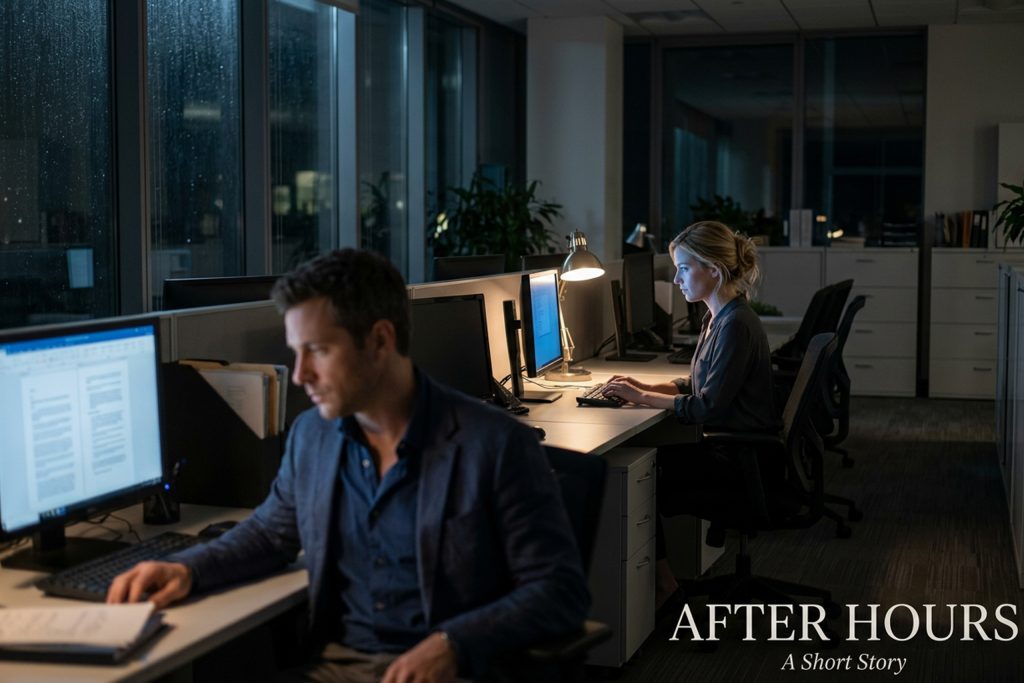
Part One: The Watching
Victoria Chen woke at 5:47 AM without an alarm, the way she always did, her body trained to efficiency the way other people’s bodies were trained to sleep. Her apartment on the twenty-third floor of the Meridian Tower caught the first light through floor-to-ceiling windows she’d paid too much for and never had time to enjoy. The glass was cold under her palm when she pressed her hand against it, looking down at a city that hadn’t started moving yet.
The apartment was clean in the way hotel rooms were clean — nothing out of place, nothing personal, nothing that suggested a life was being lived here rather than merely housed. One orchid on the kitchen island, a gift from her mother that she’d kept alive for three years through rigid watering schedules. One bookshelf with legal texts and exactly four novels she’d read in law school and never replaced. One closet of suits in navy, charcoal, and black, arranged by formality level. One drawer of lingerie she bought online at 2 AM and never wore because there was never anyone to wear it for.
Her mother called at 6:15, right on schedule, the way she’d called every Tuesday and Friday for seven years.
“Are you eating?” her mother asked in Mandarin, skipping hello the way she always did.
“I’m eating.”
“Are you dating?”
Victoria poured coffee into a mug that said WORLD’S OKAYEST LAWYER — a gift from the summer associate class two years ago, the one Marcus had supervised. “I’m dating the Q3 projections, Ma. Very committed relationship.”
“Not funny.”
“It’s a little funny.”
Her mother made a sound that translated across all languages: maternal disappointment. “You’re twenty-nine. When I was twenty-nine, I had you and your brother and I was pregnant with your sister.”
“You also lived in a village with one electrical outlet. Different circumstances.”
“Circumstances,” her mother repeated, the word heavy with judgment. “You hide behind that word. You hide behind your job. You hide behind that apartment with the windows you told me cost more than my house.”
Victoria looked at the windows. The sun had cleared the horizon now, turning the glass from cold blue to warm gold. “I’m not hiding, Ma. I’m building.”
“Building what? A career is not a life. A career is what you do while you’re waiting for a life.”
The line went quiet. Victoria’s mother had a talent for landing a sentence like a scalpel and then walking away before the bleeding started.
She finished her coffee standing up, the way she did everything — fast, without ceremony, already thinking about the deposition at ten, the client meeting at two, the Q3 projections she’d promised Marcus she’d review before the partner meeting on Thursday. She’d already reviewed them. She’d memorized them. She was going to review them again because it gave her an excuse to be in the conference room after hours, and being in the conference room after hours gave her an excuse to be near Marcus.
She knew this was pathetic. She was a senior associate at Meridian & Cross, a firm that handled nine-figure mergers and defended Fortune 500 companies in class-action litigation. She’d graduated summa cum laude from Columbia Law. She’d argued and won a summary judgment motion against a team of partners from Latham & Watkins who had sixty combined years of experience on her. She was not the kind of woman who manufactured excuses to be near a man.
And yet.
She put on her armor — navy suit, white blouse, pearl earrings her father had given her before he died, heels that added three inches to her five-foot-four frame — and she went to war.
The offices of Meridian & Cross occupied floors forty-two through forty-five of the Meridian Tower, which meant Victoria’s commute was a forty-three-second elevator ride. She’d chosen the apartment for the building, and she’d chosen the building for the firm, and she’d chosen the firm for Marcus Webb, though she would never admit that to anyone, least of all herself.
She stepped off the elevator at 7:02 AM. The floor was empty except for the night cleaning crew packing up their equipment and Marcus, who was always there before everyone else, who had likely been there since six, who treated sleep as an inconvenience rather than a biological necessity.
His office door was open. She could see him through the glass — sleeves already rolled to his elbows, phone pressed to his ear, free hand sketching something on a legal pad. His hair was gray at the temples now, more than when she’d started, but the rest of him looked exactly the same: the shoulders of a former college swimmer, the hands of a man who’d spent thirty years gesturing in courtrooms, the jaw that tightened when he was thinking and relaxed when he’d figured something out.
She’d catalogued all of it. Two years of observation, two years of sitting in meetings and pretending to take notes while actually memorizing the way his voice dropped half an octave when he was about to make his strongest point, the way he tapped his pen against his palm three times before overruling an objection, the way he looked at her — really looked, not the perfunctory eye contact he gave everyone else — when she said something smart.
He looked at her now, through the glass, and raised his coffee cup in a salute. She raised hers back. This was their ritual: two caffeine addicts acknowledging each other across the empty floor, the only two people in the building who understood that ambition was a hunger that didn’t let you sleep.
She went to her office, closed the door, and spent the next eleven hours being excellent at her job.
At 6:30 PM, the client dinner began.
It was at Delmonico’s, the kind of steakhouse where the menus didn’t have prices and the wine list was thicker than most legal briefs. The client was a tech founder named David Chen — no relation, though he’d made the joke twice — who was selling his company to a private equity firm for $340 million and needed Meridian & Cross to make sure the deal didn’t kill him on tax liability.
Marcus sat at the head of the table. Victoria sat to his right. This was also their ritual: at client dinners, she was his second, his tactical reserve, the associate who could jump in with the precise citation or the regulatory nuance that would close the deal. They’d done this together forty or fifty times, and they’d developed a rhythm that felt almost telepathic — he’d start a sentence, she’d finish it; she’d raise an eyebrow, he’d pivot his argument.
David Chen watched them work with the expression of a man watching a magic trick.
“How long have you two been doing this together?” he said, somewhere between the second course and the third glass of wine.
“Two years,” Marcus said.
“Feels longer,” Victoria said, and regretted it the instant the words left her mouth — the way it sounded, the way Marcus’s eyes flicked to her for a fraction of a second before returning to the client.
“Good team,” David Chen said. “My wife and I have been together fifteen years. We finish each other’s sentences too.”
Victoria’s face heated. She covered it with a sip of wine — a 2014 Barolo that tasted like velvet and regret — and didn’t look at Marcus for the rest of the dinner.
But she felt him. She always felt him. It was like standing near an open oven: you didn’t have to touch it to know the heat was there.
The dinner ended at 9:15. David Chen shook hands, promised to review the term sheet, and climbed into a black car that whispered away into the Manhattan night. Victoria and Marcus stood on the sidewalk outside Delmonico’s, the city moving around them in streams of headlights and hurried pedestrians, and for a moment neither of them spoke.
“I should go home,” Victoria said.
“You should.”
“I have the Q3 projections to review.”
“You’ve already reviewed them. Twice.”
She looked at him. The streetlight caught the gray at his temples, the lines around his eyes that deepened when he was tired. He was tired now. She could see it in the way he held his shoulders — a fraction lower than usual, the armor slipping.
“How do you know I’ve reviewed them twice?”
“Because I’ve reviewed them three times,” Marcus said. “And I know you.”
A taxi honked. A couple walked past, laughing at something private. The air smelled like grilled steak and exhaust and the faint floral perfume of the woman who’d just passed.
“We could go back to the office,” Victoria said, and her voice came out steady, which surprised her, because her heart was beating in a way that felt nothing like steady. “Review them together.”
Marcus was quiet for a long moment. Long enough that she had time to regret the offer, to compose three different ways to take it back, to imagine the polite rejection he was about to deliver.
“Victoria.”
“Marcus.”
“If we go back to the office right now —”
“I know.”
“— I don’t think we’re going to review the Q3 projections.”
The city kept moving. The headlights kept streaming. Somewhere a siren started its climb toward urgency. Victoria stood very still, her heels planted on the concrete, her hands at her sides, her whole body a question she was afraid to ask out loud.
“I know,” she said again.
Marcus looked at her the way he looked at her in courtrooms when he was about to make the argument that would win everything or lose everything. “Do you want to go home?”
“No.”
“Then let’s go review the projections.”
They walked back to the Meridian Tower in silence, not touching, not talking, the space between them charged with something that felt like the moment before a thunderstorm — that heavy, waiting quality, the air thick with what was about to happen.
Part Two: The Conference Room
The conference room blinds had broken months ago and no one had fixed them, stuck halfway open, and at 9:47 PM the city lights striped across the mahogany table in uneven bands — gold, black, gold — like a barcode scanning something that couldn’t be priced. Victoria sat at the head of the table, her laptop glowing blue against her face, pretending to review the Q3 projections she’d memorized two days ago.
She was actually watching Marcus.
He stood at the whiteboard, marker in hand, shirt sleeves rolled to his elbows, explaining something about market saturation that she’d stopped listening to ten minutes ago. His back muscles moved under the thin cotton of his dress shirt. She knew the anatomy of that back — the valley of his spine, the wings of his shoulder blades, the way his left trapezius tightened when he reached to write something high on the board — because she’d studied it for two years, the way a scholar studies a forbidden text.
She knew other things too. She knew he’d been divorced for six years, that his ex-wife lived in Boston with a venture capitalist named Todd, that Marcus had wanted children and she hadn’t, that the divorce had been civil on paper and devastating in practice. She knew he ran five miles every morning along the East River, that he listened to jazz while he worked and classical while he drove, that he’d once spent an entire weekend reading a single Supreme Court dissent because he thought the logic was “beautiful.” She knew he’d hired her despite being attracted to her — he’d never said this, but she knew, the way women in male-dominated professions always knew — and that he’d spent two years being scrupulously, painfully, impeccably professional about it.
She knew all of this because she’d collected it, piece by piece, the way she’d collected evidence for every case she’d ever won. The difference was that this evidence wasn’t building toward a verdict. It was building toward nothing. Toward a fantasy she indulged at 2 AM in an apartment that felt like a hotel room, wearing lingerie no one would ever see.
“Victoria?” The marker snapped back into the tray. “You’re not even pretending to pay attention anymore.”
She blinked. Marcus had turned around. He was looking at her with an expression she couldn’t quite read — amusement, maybe, or something adjacent to it, something with sharper edges.
“I’m tired,” she said, which was true, and also not the reason.
Marcus crossed the room and sat on the edge of the table, close enough that his knee brushed hers. The contact was accidental — likely accidental — but neither of them moved away from it. He smelled like the gin and tonic he’d had at dinner, like the cedar cologne she’d once identified in a department store by standing in the men’s section for fifteen minutes, spraying test strips until the sales associate asked if she needed help and she’d fled without buying anything.
“We should call it,” he said. “This isn’t productive.”
“Probably not.”
But neither of them moved. The HVAC hummed its endless white noise. Somewhere in the building, a vacuum started — the night crew, working their way through the empty floors. They were alone, officially, had been for an hour. Unofficially, they’d been alone since 6 PM when the intern left and the paralegals cleared out, since the moment the office emptied and the pretense of normalcy became harder to maintain.
“You’re staring,” Marcus said.
“So are you.”
He laughed, a low sound that started in his chest and didn’t quite reach his eyes. “You’re my direct report. I’m forty-two. You’re twenty-nine. This is —”
“A terrible idea,” Victoria said.
“The worst.”
“Completely unprofessional.”
“Completely.” He was still smiling, but his hand had moved to the table’s edge, fingers inches from her thigh. She could feel the heat of them through the air, through the wool of her skirt, through every layer of professionalism she’d constructed over two years. “We could stop. Go home. Pretend this never happened.”
“We could.”
Neither of them moved.
Victoria thought about the HR handbook, the anti-fraternization policy she’d signed at orientation, the career she’d built through seventy-hour weeks and a complete absence of personal life. She thought about her mother, who’d called this morning to ask if she was dating anyone, and the lie she’d told — I’m dating the Q3 projections, Ma — which wasn’t even a good lie, which her mother had seen through at once.
She thought about the two years she’d spent watching Marcus Webb. The client dinners where she’d sat to his right and felt the heat of his arm near hers. The late nights when they’d been the last two people on the floor and he’d walked her to the elevator and said goodnight in a voice that sounded like he was saying something else. The time she’d spilled coffee on her blouse before a partner meeting and he’d handed her his jacket without a word, and she’d worn it for three hours, surrounded by his smell, and given it back at the end of the day with a thank-you that felt absurdly inadequate.
She thought about the fact that she was twenty-nine years old and had never been in love, not really, not the kind of love that rearranged your internal furniture and made you stupid and brave in equal measure. She’d been too busy. Too focused. Too afraid, if she was honest — afraid of what would happen if she let someone see the person underneath the lawyer, the woman who wasn’t always certain, who sometimes woke up at 3 AM with the conviction that she’d built her entire life wrong.
Then she thought about Marcus’s hands — capable, certain, the hands that held a courtroom silent, the hands that had buttoned his jacket around her shoulders — and how they would feel on her skin.
“What if —” she said.
“I know.”
“What if we just —” she gestured without direction, without hope, between them — “for tonight? Just this once. Then we go back to being professional and never mention it again.”
His smile faded. The amusement drained out of his expression, replaced by something heavier, something that looked almost like grief. “You think that’s possible?”
Victoria opened her mouth to say yes. The lie was right there, ready to go, the same lie she’d been telling herself for two years. But something stopped her — maybe the gin, maybe the hour, maybe the way he was looking at her like he already knew the answer and was just waiting for her to catch up.
“No,” she said.
“Me neither.” He stood, and for a moment she thought he was leaving, and her chest constricted with something that felt embarrassingly like grief — actual grief, the kind you felt when you lost something you’d never really had. But he only walked to the door and locked it. The click was loud in the empty room, a sound that divided time into before and after.
He turned back to her. The city lights striped his face now — gold across his eyes, black across his mouth, gold across the hands that hung at his sides, waiting.
“Victoria,” he said, and her name in his voice was different now, the professional distance stripped away he’d always maintained. “I need you to understand something. This isn’t — this isn’t casual for me. It hasn’t been casual for two years. If we do this, I don’t know how to go back. I don’t think I can.”
Her throat tightened. “Marcus —”
“I hired you because you were the best candidate. You were also the candidate I couldn’t stop thinking about after the interview. I told myself I was being professional. I told myself it would fade. It didn’t fade.” He took a step toward her, then stopped, as if he’d hit an invisible barrier. “I’ve spent two years sitting next to you in meetings, watching you argue motions, watching you destroy opposing counsel who underestimated you, and every single time I thought: this woman is extraordinary, and I can’t touch her, and it’s killing me.”
Victoria stood up. Her laptop beeped — a low-battery warning, mundane and absurd in the charged silence of the room. She ignored it.
“You never said anything,” she said.
“What was I supposed to say? ‘Victoria, I’m your boss and I’m attracted to you, would you like to destroy both our careers?'”
“I would have said yes.”
The words hung in the air between them. Marcus stared at her, and she watched him process what she’d just admitted — the two years of watching had been mutual, the tension had been mutual, the wanting had been mutual, and they’d both been too afraid to name it.
“You would have said yes,” he said, as if testing the words for structural integrity.
“Two years ago. A year ago. Yesterday. Right now.” She took a breath that felt like the first real breath she’d taken in a decade. “I’ve been watching you since my first week. I know your back muscles. I know the way you tap your pen before you overrule an objection. I know you run five miles every morning and listen to jazz while you work and spent an entire weekend reading a Supreme Court dissent because you thought the logic was beautiful. I know you hired me despite wanting me, and I know you’ve been suffering about it, and I know because I’ve been suffering about it too.”
Marcus crossed the remaining distance between them in three strides. He didn’t touch her — not yet — but he was close enough now that she could see the flecks of gold in his brown eyes, the small scar on his chin from some accident he’d never mentioned, the way his breathing had changed, become shallow, become something closer to desperate.
“Tell me what you want,” he said.
“You.”
“Tell me specifically.”
“I want you to stop being my boss for one night. I want you to touch me. I want to stop pretending I don’t think about you every time I’m in this room, every time I’m anywhere near you, every time I’m alone in my apartment at 2 AM.” Her voice cracked on the last word, and she didn’t care. “I want this, Marcus. I’ve wanted it for two years. I’m tired of wanting it from a distance.”
He reached up and touched her face — just his fingertips, just along the line of her jaw, a touch so light it was almost not a touch at all. But it sent a current through her, electric and undeniable, the way lightning finds the highest point and strikes.
“Tell me to stop,” he said.
“Don’t stop.”
“Tell me you want this.”
“I want this.”
“Say my name.”
“Marcus.” It came out breathier than she intended, younger, the voice of a woman who’d finally stopped performing. “Please.”
That was the word that broke him — please — because his mouth was on hers then, hungry and precise, the same way he argued cases. His tongue traced the seam of her lips and she opened for him, fingers tangling in his hair, pulling him closer with a force that surprised them both. The conference table pressed cold against her back where he’d lifted her onto it, papers scattering, her laptop sliding toward the edge with a mechanical whine.
He caught it one-handed, never breaking the kiss, and set it on the floor.
“Expensive,” he said against her neck, his breath hot on the tendon that ran from her jaw to her ear.
“You’re distracting me.”
“Good.”
Part Three: The Permission
He didn’t rush. That was what she would remember later — the deliberation of it, the way he treated her body like a deposition he needed to take carefully, every question asked in sequence, every answer given its full weight. His hands found her waist first, thumbs pressing into the space above her hip bones, holding her still while he looked at her.
The city lights painted them both in gold and shadow. The vacuum had stopped somewhere in the building. The only sounds were their breathing and the distant hum of the HVAC and the blood rushing in Victoria’s ears like a river she’d been damning for years and had finally released.
“I need you to know something,” Marcus said, his voice low and rough, the courtroom polish stripped away. “This isn’t just physical for me. It hasn’t been just physical since the day you walked into your interview in that red blouse and dismantled every argument I threw at you.”
“I remember that blouse.”
“I remember everything about that day. You sat in the chair across from my desk and you weren’t intimidated — every candidate before you had been intimidated, and you weren’t. You looked at me like you were already planning how to beat me. I thought: this woman is going to be a problem. And then I thought: I want her anyway.”
Victoria’s hands were on his chest now, feeling his heartbeat through the cotton of his shirt — faster than she’d expected, faster than the controlled exterior suggested. “You hired me.”
“Worst and best decision I’ve ever made.” He kissed the corner of her mouth, the hinge of her jaw, the hollow beneath her ear where her pulse beat visible and fast. “Worst because I’ve spent two years in a state of low-grade torture. Best because you’re the finest lawyer I’ve ever trained, and watching you become what you’ve become has been the privilege of my career.”
She pulled back far enough to look at him. “You’ve never said that before.”
“I’ve never said a lot of things before.”
“Say them now.”
He held her gaze. The gold light from the broken blinds moved across his face as a cloud passed outside, shifting the pattern, making him look younger for a moment, then older, then something timeless.
“I think about you constantly,” he said. “In meetings, in court, at home alone in an apartment that’s too big for one person. I think about the way you tilt your head when you’re about to make your strongest argument. I think about the sound you make when you’re frustrated with a brief — that small exhale through your nose. I think about the fact that you’re twenty-nine and you’ve already accomplished more than most lawyers do in a career, and you’re still hungry, still pushing, still showing up at 7 AM because you can’t stand to be anywhere else.”
“I show up at 7 AM because you’re here,” Victoria said.
The confession landed between them like a coin dropped into deep water. Marcus’s hands tightened on her waist.
“I know,” he said. “I’ve always known. I pretended I didn’t because pretending was easier than doing something about it.”
“And now?”
“Now I’m done pretending.”
He kissed her again, deeper this time, his tongue sliding against hers with the same precision he brought to cross-examinations — exploring, mapping, learning the territory. His hands moved from her waist to the small of her back, pressing her against him, and she felt the full length of his body for the first time: the solid chest, the flat stomach, the hardness pressing against her hip that made her breath catch.
She’d imagined this. Hundreds of times. In the shower with the water beating against her shoulders. In bed with her hand between her thighs and his name on her lips. In the bathroom during all-hands meetings, locked in a stall, trying to compose herself after he’d looked at her a certain way across the conference table. But the reality was sharper, more textured, more overwhelming than any fantasy.
His mouth left hers and traveled down — her chin, her throat, the hollow where her collarbones met. His tongue traced the ridge of bone, and she made a sound she’d never made before, a sound that came from somewhere deeper than her voice.
“You’ve thought about this,” he said against her skin.
“Constantly.”
“Tell me what you thought about.”
She hesitated. The request was intimate in a way that felt more exposing than the physical contact — asking her to narrate her desire, to give voice to the fantasies she’d kept locked in the private dark of her own mind.
“Everything,” she said. “Your hands. Your mouth. The way you’d sound. Whether you’d be gentle or rough. Whether you’d talk or stay silent. Whether you’d look at me or close your eyes.”
“I’m going to look at you,” Marcus said. “I’m always going to look at you.”
He unbuttoned her blouse with the same care he’d used to button his jacket around her shoulders two years ago — slow, deliberate, each button a decision. The silk parted, and the air of the conference room touched her skin, cool against the heat she was generating from the inside out. He didn’t remove the blouse, just opened it, just looked at her — the black lace bra she’d bought at 2 AM three months ago, the rise and fall of her chest, the flush that was spreading from her throat to her sternum.
“Beautiful,” he said, and the word was simple and absolute, the way he said sustained or overruled in court — not an opinion, a finding of fact.
She reached for his shirt, fingers fumbling with the buttons in a way they never fumbled with anything. He helped her, his hands covering hers, guiding them through the task. Then his shirt was open and she was touching his chest — the muscle beneath the skin, the scattering of gray hair, the flat brown nipples that tightened under her fingertips.
“You run,” she said, tracing the definition of his pectorals.
“Five miles. Every morning.”
“I know.”
He smiled — a real smile, not the professional one he used with clients, not the sharp one he used with opposing counsel. “You really have been watching.”
“For two years. I told you.”
His shirt came off, then hers, and the sight of him — lean, scattered with gray at his temples, the body of a man who ran marathons but also ate steak, who was forty-two and in better shape than most thirty-year-olds she knew — made her feel dizzy. She’d imagined this. But the reality was sharper. The reality had smell and texture and the specific sound of his breathing, which had gone ragged at the edges.
He reached behind her and unhooked her bra with a competence that made her raise an eyebrow.
“Divorced,” he said. “Not dead.”
She laughed, high and nervous, and he swallowed the sound with another kiss. Her bra fell away, and then his hands were on her breasts — not grabbing, not rushing, just holding, thumbs brushing across her nipples with the lightest possible pressure. She arched into his palms, her spine curving, her head falling back.
“Victoria,” he said, and her name in his mouth was a prayer and a question and a declaration all at once.
“More,” she said. “Please. More.”
Part Four: The Main Event
He lifted her off the table just long enough to sweep the remaining papers aside — Q3 projections, abandoned Post-its, a leather-bound portfolio that landed on the floor with a slap. Then she was on her back on the mahogany, the wood cool against her shoulder blades, and Marcus was above her, braced on his forearms, the city lights striping his bare shoulders in alternating bands of gold and shadow.
The blinds were still broken. The night was still watching. Victoria didn’t care.
He kissed her mouth, then her throat, then the valley between her breasts. His tongue traced a path down her sternum, pausing at her navel, dipping into the small depression and making her stomach muscles contract. She could feel every inch of the journey — the wet heat of his mouth, the scratch of his stubble against her skin, the way his breath changed temperature as he moved lower.
His hands found the waistband of her skirt. He looked up at her, his eyes dark in the half-light, asking a question without words.
“Yes,” she said. “Everything. Yes.”
The skirt came off. The stockings came off. The black lace underwear she’d bought at 2 AM came off, and then she was naked on the conference table where she’d sat through a hundred meetings, where she’d argued motions and reviewed contracts and pretended not to notice the way Marcus looked at her when he thought she wasn’t looking back.
He stood at the edge of the table, looking down at her, and the expression on his face was something she’d never seen before — not in court, not in meetings, not in any of the hundreds of hours she’d spent cataloguing his expressions. It was reverence. It was hunger. It was the look of a man who had wanted something for so long that having it felt like a religious experience.
“You’re shaking,” he said.
“I’m nervous.”
“Don’t be nervous. It’s just me.”
“It’s not just you. It’s you. It’s two years of wanting you. It’s —” She stopped, swallowed, started again. “I’ve never done anything like this. I’ve never wanted anyone like this.”
He bent down and kissed her hip bone — the left one, the one that protruded a fraction more than the right, a asymmetry she’d always been self-conscious about. His lips lingered there, and then his tongue traced the hollow beneath the bone, the soft depression where her thigh met her torso, the place where her pulse beat close to the surface.
“I’ve got you,” he said against her skin. “I’ve got you, Victoria.”
His mouth moved inward. Her thighs fell open, involuntary and absolute, a surrender her body made before her mind could approve it. His tongue found her — not tentative, not hesitant, but with the focused precision of a man who knew exactly what he was doing and had been waiting a very long time to do it.
The first contact drew a sound from her that she didn’t recognize as her own voice. It was higher than her normal register, less controlled, the voice of a woman who had spent her entire adult life being in control and was now, for the first time, letting go.
He worked her with the same methodical intensity he brought to oral arguments — building with patience, reading her responses, adjusting his approach based on the evidence of her body. His tongue traced circles that tightened and loosened and tightened again, a rhythm that kept her suspended between predictable and desperate. His hands held her thighs open, thumbs pressing into the soft flesh of her inner legs, anchoring her to the table.
She grabbed the edge of the mahogany with both hands. The wood was smooth and cool under her palms, a grounding sensation in a body that was losing fast its connection to the ground. Her hips began to move — small circles at first, then larger, matching the rhythm of his mouth, a counterpoint she couldn’t have controlled if she’d tried.
“There,” she said, and the word came out strangled. “Right there. Don’t stop. Please don’t stop.”
He didn’t stop. He stayed right where she needed him, pressure and motion and heat, and she felt the orgasm building at the base of her spine — a tightening, a gathering, a wave pulling back from the shore before it crashed. Her breathing went shallow. Her vision went strange at the edges. The city lights outside the broken blinds blurred into streaks of gold that seemed to pulse in time with her heartbeat.
“Marcus —” His name broke apart in her mouth, the syllables separating like a sentence she couldn’t finish.
He made a sound against her — a hum of acknowledgment, of encouragement, of something that might have been his own pleasure reflected back at her — and the vibration pushed her over the edge. She came with her back arched off the mahogany, her hands gripping the table’s edge hard enough to leave marks, her voice saying his name over and over like a word she’d just learned and couldn’t stop practicing.
He stayed with her through the whole thing — mouth steady, hands steady, anchoring her while she came apart. Only when her body went limp, when her hands released the table and her breathing started to slow, did he lift his head and look at her.
His mouth was wet. His eyes were dark. His chest was rising and falling with a rhythm that matched hers.
“Come here,” she said. “I need you inside me. Now.”
He stood and removed his belt. The leather slid through the buckle with a sound that was ordinary and obscene at the same time — a sound she’d heard a thousand times in contexts that meant nothing, and now would never hear the same way again. His pants fell. His boxer briefs followed. And then he was naked in the striped light of the broken blinds, and Victoria looked at him — all of him — and felt her breath stop.
He was beautiful in the way that men who took care of themselves were beautiful: functional, proportional, the body of someone who treated physicality as a responsibility rather than an asset. His erection curved upward toward his stomach, and she watched it move slightly with his pulse, a small, involuntary motion that was somehow the most erotic thing she’d ever seen.
“Condom,” she said, because she was still a lawyer, still capable of risk assessment even when every other cognitive function had shut down.
“Wallet,” he said, and retrieved it from his discarded pants with hands that were not quite steady.
She watched him roll it on — the practiced efficiency of it, the way his fingers knew the motion without conscious direction. Then he was standing at the edge of the table again, looking down at her, and the moment stretched between them like a held breath.
“Last chance,” he said. “Tell me to stop and I stop. No questions, no consequences, no —”
“Marcus.” She reached up and touched his face — the jaw she’d watched tighten and relax through a hundred meetings, the mouth she’d imagined on her skin a thousand times. “I’ve been waiting two years. Don’t make me wait any longer.”
He positioned himself at her entrance, and she felt the heat of him there — not pushing, just present, a promise about to be fulfilled. His left hand braced on the table beside her head. His right hand held her hip, thumb pressing into the hollow beneath the bone.
“Look at me,” he said.
She looked at him.
“Stay with me. Right here. Don’t go anywhere else in your head. Stay right here with me.”
“I’m here,” she said. “I’ve always been here.”
He entered her.
The first inch was a negotiation — her body adjusting to his, the stretch and give of tissue that hadn’t accommodated anyone in longer than she wanted to admit. He moved with the controlled precision of a man who had spent two years imagining this exact moment: slow, then slower, then slower still, until she thought she might die from the pace of it.
Her breath caught. Her hands found his shoulders, fingers digging into the muscle there, holding on.
“Okay?” he said.
“More than okay. Keep going.”
He kept going. Another inch, another pause, another adjustment. He was reading her body the way he read contracts — carefully, thoroughly, missing nothing. Her legs wrapped around his waist, heels pressing into the small of his back, pulling him deeper.
“There,” she said when he was fully seated inside her. “Right there. Don’t move yet. Just — let me feel this.”
He held still. The city lights striped their joined bodies. The HVAC hummed its endless white noise. Somewhere in the building, the night cleaning crew moved through another floor, oblivious to what was happening forty-three stories above the street.
Victoria felt full in a way that was physical and emotional and temporal all at once — full of him, full of the two years that had led to this moment, full of a want that had finally found its object. She looked up at Marcus’s face and saw her own expression reflected there: wonder, hunger, the slight terror of getting exactly what you’d asked for.
“Now,” she said. “Move. Please.”
He began to move inside her, and the conference room became a broadcast booth, and every moment of what happened next deserved its own narration.
First position: missionary on the mahogany table, her back flat against the wood, her legs wrapped around his waist, his forearms braced on either side of her head. He established a rhythm — slow and deep, each thrust a full sentence rather than a fragment. The table creaked beneath them, a metronome of want, mahogany against its frame in counterpoint to the sound of his hips meeting hers.
He watched her face while he moved. She knew this because she was watching his — the way his jaw tightened on each entry, the way his eyes half-closed on each withdrawal, the way his breathing synchronized with his motion until the three of them — breath, body, beat — became a single instrument.
“Faster,” she said, and the word came out as a command, the voice of a woman who was used to giving instructions and having them followed.
He obeyed. The rhythm accelerated — still deep, but faster now, the pauses between thrusts shortening until they disappeared entirely. The table’s creaking became a continuous sound, a low wooden moan that harmonized with the HVAC and the distant sirens and the blood rushing in her ears.
Her hips rose to meet him — a countermove, a challenge, her body answering his in a language neither of them had spoken before tonight. She matched his rhythm and then pushed against it, creating a syncopation that made him groan, a sound that started deep in his chest and escaped through clenched teeth.
“Victoria —” Her name in his mouth was a warning and a celebration.
“I know,” she said. “I feel it too.”
He shifted his weight to his left forearm, freeing his right hand — tactical adjustment, and she knew it the second before his thumb found her, knew it from the sharp intake of breath that wasn’t hers. His thumb settled against her clitoris with the accuracy of a man who read bodies the way he read contracts — precise, informed, devastating.
The dual stimulation changed everything. She’d been climbing before; now she was accelerating. Her inner muscles tightened around him, and she felt his rhythm falter for half a beat — a stutter in the otherwise flawless execution, a sign that he was as affected as she was.
“Don’t stop,” she said. “Whatever you do, don’t stop.”
“I’m not stopping.” His voice was strained now, the courtroom control cracking at the edges. “I’m not — I couldn’t stop if I —”
He didn’t finish the sentence. He didn’t need to. His body was saying everything his voice couldn’t.
Second position: he pulled out — she made a sound of protest that was almost animal — and flipped her onto her stomach in a single motion, his hands on her hips, positioning her at the edge of the table. She braced herself on her forearms, the mahogany cool against her breasts, her spine curving into an arch that felt primal and obscene and exactly right.
He entered her from behind, and the angle was different — deeper, more direct, hitting a place inside her that made her vision white out for half a second. Her hands scrabbled against the table’s surface, looking for purchase, finding none. She grabbed the far edge instead, holding on like a climber on a sheer face.
“Okay?” he said, and the fact that he was still checking, still making sure, even now, even in the middle of this — that was the thing that would stay with her later, the thing that would make her understand that this was more than sex.
“Yes,” she said. “God, yes. Don’t stop.”
He didn’t stop. He established a new rhythm — three shallow thrusts, then one deep, a pattern he built and broke and built again, keeping her suspended in the gap between predictable and desperate. His hands gripped her hips hard enough to leave marks, and she wanted the marks, wanted evidence that this had happened, that it wasn’t another 2 AM fantasy she’d wake up from alone.
The city lights kept striping the table. The blinds kept rattling in the HVAC breeze. The world outside the conference room had ceased to exist — there was only this room, this table, this man, this rhythm, this building pressure at the base of her spine that was going to break her apart for the second time tonight.
“Marcus, I’m —” The words wouldn’t form. Her thoughts had fragmented into images and sensations: the sound of his breathing, the feel of his fingers digging into her flesh, the smell of sex and cedar and gin, the taste of her own sweat on her upper lip.
“I know,” he said. “I can feel it. Let go. I’ve got you.”
She let go. The orgasm hit her like a tide she’d been watching rise for hours — inevitable, overwhelming, total. She came around him, her body clenching in rhythmic pulses that drew a groan from his chest, her voice saying things that weren’t words, her hands gripping the table’s edge with a force that turned her knuckles white.
He followed her over the edge three thrusts later — she counted them, would always remember counting them: one, two, three, and then his rhythm broke entirely, his body going rigid, his forehead pressing into the space between her shoulder blades as he emptied himself with a sound that was half her name and half something wordless and raw.
They stayed like that for a long moment — him bent over her, her sprawled across the table, both of them breathing like swimmers after a long dive. The HVAC hummed. The city glittered. The broken blinds cast their indifferent stripes across two people who had just demolished every professional boundary they’d spent two years constructing.
Part Five: The Aftermath
He pulled out carefully, and she felt the loss of him as a physical ache — her body already missing what it had just learned to hold. He disposed of the condom in the conference room wastebasket, a gesture so mundane it was almost funny, and then he helped her sit up, his hands gentle on her shoulders.
Neither of them spoke. The silence wasn’t awkward; it was full, dense with everything that had just happened, everything that needed to be processed before words could be trusted again.
He helped her dress with the same care he’d used to undress her — finding her underwear on the floor, handing it to her without ceremony, holding her blouse while she slid her arms into the sleeves. He buttoned it for her, starting at the bottom and working up, his fingers nimble with practice. He found her skirt, her stockings, her heels that had somehow ended up under the whiteboard.
She watched his face while he dressed her, looking for regret, for the morning-after panic that should follow a decision like this. She found only a softness she’d never seen in him before — the courtroom armor gone, replaced by something tender and uncertain and young.
He dressed himself with less ceremony — pants, shirt, belt, the pieces of his professional identity reassembling around him. He didn’t button his shirt all the way. He didn’t tuck it in. He looked, for the first time since she’d known him, like a man who had stopped caring about appearances for the moment.
“What happens now?” Victoria said.
The question hung in the air between them. Outside, the city kept moving — headlights streaming up Sixth Avenue, a helicopter thudding somewhere in the distance, the eternal hum of eight million people living their lives while two of them stood in a conference room trying to figure out if they’d just made the best or worst decision of their careers.
Marcus buttoned his shirt the rest of the way, fingers moving with the automatic precision of long habit. “Now we go home. We sleep. We come back tomorrow and pretend this never happened.”
“Can you do that?”
His hands stilled on the last button. He looked at her — really looked, the way he’d looked at her during the sex, the way he’d looked at her during the interview two years ago, the way he’d been looking at her in meetings and courtrooms and client dinners for seven hundred and thirty days.
“No,” he said.
“Me neither.”
He crossed the room and stood in front of her, close enough that she could smell herself on his skin, could see the small red marks her nails had left on his shoulders. He touched her face again — the same gesture as before, fingertips along her jaw, but different now, weighted with everything that had happened between the first touch and this one.
“Then I guess,” he said slowly, “we figure it out together.”
“Together how? You’re still my boss. I’m still your direct report. The firm still has an anti-fraternization policy that —”
“I know the policy. I helped write it.”
“Then you know what happens if anyone finds out.”
“I know.” His thumb traced the line of her cheekbone, a gesture so tender it made her chest ache. “I also know that I’ve spent six years alone in an apartment that’s too big for one person, and two years wanting a woman I couldn’t have, and I’m tired of letting fear make my decisions.”
Victoria stared at him. “You’re talking about — what, exactly? Going public? One of us leaving the firm?”
“I’m talking about not pretending. Whatever that looks like. Whatever it costs.” He kissed her forehead — chaste, almost paternal, a promise rather than a demand. “I’m not asking you to decide anything tonight. Go home. Sleep. We’ll talk tomorrow.”
“Tomorrow is Thursday. We have the partner meeting at ten.”
“Then we’ll talk after the partner meeting.”
“And until then? We just — act normal?”
“Can you act normal?”
Victoria thought about it. Thought about sitting across from him in the partner meeting, watching him present the Q3 projections, knowing what his body felt like inside hers, knowing the sound he made when he came. “No,” she said. “But I’m a very good lawyer. I’ll figure it out.”
He smiled — the real smile again, the one that made him look younger and more human and less like the implacable force of nature she’d spent two years studying from a distance. “You’re the best lawyer I’ve ever trained. You’ll figure it out.”
He kissed her once more — mouth to mouth this time, soft and brief, a period at the end of a sentence that had taken two years to write. Then he unlocked the conference room door and held it open for her, ever the gentleman, ever the lawyer, ever the man who couldn’t stop being who he was even when everything else had changed.
She walked past him into the empty hallway. The fluorescent lights hummed overhead. The night cleaning crew had moved on to another floor. The elevator bank waited at the end of the corridor, chrome doors reflecting her image back at her — a woman in a navy suit with her hair disarranged and her blouse buttoned by someone else’s hands and her heart hammering a rhythm that sounded suspiciously like hope.
She pressed the down button. The elevator arrived. She stepped inside and turned around, and the last thing she saw before the doors closed was Marcus standing in the hallway, shirt untucked, watching her go with an expression that contained everything he hadn’t said yet.
Part Six: The Retreat
The next morning, Victoria woke at 5:47 AM without an alarm, as she always did, and for four seconds everything was normal. Then her body reminded her — the ache in her inner thighs, the tenderness between her legs, the small bruises on her hips where his hands had gripped her — and the memory of the conference room flooded back with the force of a wall coming down.
She lay in her bed, staring at the ceiling, and tried to process what had happened. The sex. The conversation afterward. The way he’d looked at her in the hallway. The fact that she was supposed to see him in four hours and act like nothing had changed.
Her phone buzzed. Her mother, right on schedule, 6:15 AM.
“Are you eating?”
“I’m eating.”
“Are you dating?”
Victoria closed her eyes. “It’s complicated, Ma.”
The line went quiet. Then: “Complicated is better than nothing. Complicated means there’s something to complicate.”
“That’s either very wise or completely nonsensical.”
“Both,” her mother said. “Call me when it’s less complicated.”
She hung up. Victoria put the phone down and stared at the ceiling some more. The sun was coming through her expensive windows now, turning the glass from cold blue to warm gold, the same transition she’d watched a thousand times. But this morning it felt different. This morning everything felt different.
She put on her armor — charcoal suit today, cream blouse, the pearl earrings — and went to war.
The partner meeting was at 10 AM in the same conference room where, twelve hours earlier, she’d been naked on the mahogany table. She walked in at 9:58 and took her usual seat — not at the head, not at Marcus’s right, but three chairs down, the position of a senior associate who was important but not yet essential.
Marcus was already there, at the head of the table, reviewing his notes. He looked exactly the same as he always looked: impeccable suit, sleeves still down, hair still perfect, the mask of professional competence fully restored. He glanced up when she entered, and his expression didn’t change — no secret smile, no knowing look, nothing that would betray what had happened between them.
It was what she’d asked for. It was also devastating.
The meeting lasted two hours. Victoria took notes, offered analysis, answered questions from the partners with her usual precision. She did not look at Marcus more than was professionally necessary. She did not let her voice change when she addressed him. She performed normalcy with the same skill she brought to every performance, and no one in the room suspected anything.
But underneath the performance, she was falling apart. Every time Marcus spoke, she heard the voice he’d used in the dark — stay with me, Victoria, right here. Every time he gestured, she saw the hands that had gripped her hips. Every time he looked at her with professional neutrality, she felt the absence of the way he’d looked at her at 2 AM, like she was the answer to a question he’d been asking his whole life.
After the meeting, he caught her in the hallway.
“Victoria. A word?”
It was the tone he used with all the associates — pleasant, professional, unremarkable. She followed him to his office, and he closed the door, and the second the glass separated them from the rest of the floor, his expression changed.
“Are you okay?” he said.
“I’m fine.”
“You’re not fine. You wouldn’t look at me during the meeting.”
“I looked at you the normal amount.”
“You looked at me the amount you’d look at someone you were trying not to look at.”
Victoria sat down in the chair across from his desk — the same chair she’d sat in for her interview two years ago, the red blouse and the dismantled arguments and the moment she’d first thought: this man is going to be a problem. “What do you want me to say, Marcus? That I can’t stop thinking about last night? That I sat in that conference room for two hours and all I could think about was your hands on my body? That I’m terrified?”
“All of that. Say all of that.”
“I’m terrified,” she said. “I’m terrified of what happens if someone finds out. I’m terrified of what happens to my career. I’m terrified of what happens to your career. I’m terrified that this was a mistake and I’m going to spend the next ten years regretting it. And I’m also terrified that it wasn’t a mistake, and that I’m going to want it again, and that wanting it again is going to destroy everything I’ve built.”
Marcus sat down behind his desk. The distance between them — six feet of oak and leather and professional hierarchy — felt like a mile.
“I’ve been thinking about the same things,” he said. “All night. I didn’t sleep.”
“Me neither.”
“There are options. One of us could transfer to another practice group. I could recuse myself from supervising you. We could —”
“Or we could stop,” Victoria said. “We could decide that last night was a one-time thing and never do it again and go back to the way things were.”
Marcus was quiet for a long moment. Outside his office window, the city stretched toward the horizon, glass and steel and eight million people who had their own problems.
“Is that what you want?” he said.
“No.” The word came out before she could stop it. “But it might be what’s smart.”
“Victoria.” He leaned forward, his forearms on the desk, his hands clasped in front of him. “I’ve spent my entire adult life doing what’s smart. I married the woman who was smart on paper. I built the career that was smart. I made every decision based on risk assessment and strategic planning and the long-term optimization of outcomes. And I ended up forty-two years old, divorced, alone in an apartment that’s too big, with nothing in my life except this firm.”
“That’s not nothing.”
“It’s not enough. It hasn’t been enough for a long time. I just didn’t let myself admit it until last night.”
Victoria felt her throat tighten. “What are you saying?”
“I’m saying I don’t want to go back to pretending. I’m saying I don’t want to transfer you to another group or recuse myself from your cases or find some bureaucratic solution that lets us keep working together while pretending we don’t feel what we feel.” He stood up and walked around the desk, and then he was standing in front of her chair, looking down at her with the same intensity he’d had in the conference room. “I’m saying I want you. Not for one night. Not in secret. I want to figure out how to do this for real, even if it means one of us leaves the firm, even if it means —”
“One of us leaves the firm?” Victoria stood up too, her chair rolling back and hitting the bookshelf behind her. “Marcus, you’re a partner. You’ve spent twenty years building your position here. I’m a senior associate with a track record that could get me hired anywhere. If someone leaves, it should be me.”
“No.”
“It’s logical. I have less to lose.”
“It’s not about logic. It’s about —” He stopped, ran his hand through his hair, a gesture of frustration she’d never seen him make before. “I don’t want you to sacrifice your career for this. I don’t want either of us to sacrifice anything. I want to find a way that doesn’t require sacrifice.”
“There might not be one.”
“Then we find out together. Or we don’t. But I’m not willing to go back to pretending, Victoria. I can’t. Not after last night.”
She looked at him — the jaw, the gray at the temples, the hands that had held her like she was something precious — and felt the war inside her: ambition versus desire, safety versus risk, the life she’d built versus the life she might have.
“I need time,” she said. “To think. To figure out what I want.”
“Take whatever time you need.”
“And in the meantime?”
“In the meantime, we’re professional. Completely professional. No locked doors, no late nights, no —” He almost smiled. “No reviewing Q3 projections together.”
“Okay.”
“Okay.”
She walked to the door, her hand on the handle, and then stopped. “Marcus?”
“Yes?”
“Last night wasn’t a mistake. Whatever happens — it wasn’t a mistake.”
She left before he could respond, before she could see his face change, before she could take the words back. She walked down the hallway to her office, closed the door, and sat at her desk with her heart pounding and her hands shaking and the absolute certainty that she had just told the truth and the truth was going to cost her something.
Part Seven: The Falling
For two weeks, they were professional.
Professional. Impeccably professional. So professional that the other associates started making jokes about it — “Did you and Webb have a fight? You’re both being strangely formal with each other.”
Victoria smiled and said everything was fine and went back to her office and stared at her computer screen without seeing it.
She saw him every day. In meetings, in the hallway, in the break room where they’d once had their morning coffee ritual — the two caffeine addicts acknowledging each other across the empty floor. They still did the ritual, but it was different now: a nod instead of a salute, a professional distance instead of the easy camaraderie they’d had before.
She missed him. She missed him with a physical ache that surprised her — not just the sex, though she missed that too, but the way he’d looked at her, the way he’d said her name, the way he’d made her feel seen in a way no one had ever seen her before.
She went on a date. A setup from a college friend — a man named Eric who worked in finance and had good hair and asked her questions about her job and didn’t seem to listen to the answers. She sat across from him at a restaurant in the West Village and smiled in the right places and laughed at his jokes and felt nothing.
Eric walked her home and kissed her at her door, and she let him, and the kiss was fine — technically competent, adequately pleasant — and it made her want to cry, because it wasn’t Marcus’s mouth, wasn’t Marcus’s hands on her waist, wasn’t Marcus’s voice saying her name like it mattered.
She went inside, took off her dress, stood in her living room in her underwear, and called her mother.
“It’s still complicated,” she said.
“Tell me.”
So she told her. Not the details — not the conference room, not the sex, not the anti-fraternization policy — but the shape of it. The man. The two years of watching. The fear. The wanting.
Her mother was quiet for a long time after she said. Then: “Your father and I met when he was my supervisor at the textile factory. Everyone told us it was a bad idea. We did it anyway.”
“I didn’t know that.”
“You never asked. You never ask about things that might change your plans.”
Victoria sat down on her couch, the leather cold against her bare thighs. “What happened?”
“We got married. We had you. We had your brother and your sister. We were happy for twenty-three years, and then he died, and I was alone, and I have never once regretted the twenty-three years.” Her mother’s voice softened, the scalpel put away. “Victoria. You have built a very impressive life. But a life is not a career. A career is what you do while you’re waiting for a life.”
“You said that before.”
“I’ll keep saying it until you hear it.”
The next day, Victoria walked into Marcus’s office and closed the door.
“I need to talk to you,” she said.
He looked up from his desk, and she saw the hope flash across his face before he suppressed it — a micro-expression, there and gone, the kind of thing she’d trained herself to notice in depositions.
“I’m listening.”
“I’ve been thinking. For two weeks. About what I want.” She sat down in the chair across from his desk — the interview chair, the chair that had started everything. “I want you. I want this. I don’t know how to make it work without one of us leaving the firm, and I don’t know if I’m ready to leave the firm, and I don’t know if you’re ready to leave the firm, and I don’t know anything except that pretending we don’t feel this is making me miserable.”
“It’s making me miserable too.”
“So what do we do?”
Marcus stood up and walked around the desk. He sat on the edge, close to her chair, the way he’d sat on the edge of the conference table two weeks ago. “I’ve been thinking too. About options. About what I’m willing to give up.”
“And?”
“There’s a firm in Boston. Henderson & Pike. They’ve been trying to recruit me for three years. Partnership, same compensation, smaller caseload. I’ve always said no because Meridian is my home. But —” He looked at her, and his expression was the one from the conference room, the one that contained everything. “Home isn’t a building. Home isn’t a firm. I’m starting to think home might be a person.”
Victoria felt her heart stop and restart. “You’d leave Meridian? After twenty years?”
“I’d leave Meridian after forty years if it meant I could be with you without hiding.”
“Marcus —”
“You don’t have to say anything. You don’t have to decide anything. I’m just telling you what I’ve figured out on my side. The offer is there. I can take it whenever I want. If we decide to do this — really do this — I’ll take it. And then there’s no policy problem, no hierarchy problem, no —”
“What about my career?”
“What about it?”
“If you leave, and I stay, and we’re together — everyone will know why you left. They’ll say I slept with a partner to get ahead. They’ll say —”
“They’ll say whatever they’re going to say. You can’t control that. What you can control is whether you let other people’s opinions make your decisions for you.” He reached out and took her hand — the first time he’d touched her in two weeks, and the contact sent the same charge through her that it had sent in the conference room. “Victoria. You’re the best lawyer I’ve ever trained. You’re going to be a partner here, or at another firm, or wherever you want to be a partner. Your career is not going to be defined by who you love. It’s going to be defined by how good you are. And you are extraordinary.”
She looked at their joined hands — his larger, hers smaller, both capable of the same precision, the same argumentation, the same relentless pursuit of winning. “You really would leave. For me.”
“I really would leave. For us. For the possibility of us.”
“When?”
“As soon as you say yes.”
Victoria took a breath that felt like the first real breath she’d taken in two weeks. “Yes.”
“Yes?”
“Yes. I want this. I want you. I want to stop pretending and stop hiding and stop being miserable because I’m trying to be professional when all I want is to be with you.” She stood up, pulling him with her, and they were face to face now, close enough to kiss, close enough to feel each other’s breath. “Take the offer. Leave the firm. And then come find me.”
He kissed her — not the hungry kiss from the conference room, not the chaste kiss from the hallway, but something in between: a promise, a beginning, a door opening onto a future that neither of them could predict but both of them were finally willing to walk into.
“I’ll call Henderson tomorrow,” he said against her mouth.
“Call them today.”
“Today. Right now.” He was smiling — the real smile, the one that made him look younger. “And then what?”
“And then,” Victoria said, “you take me home. Your home. I’ve never seen your apartment.”
“It’s too big for one person.”
“Show me anyway.”
Part Eight: The Homecoming
Marcus’s apartment was on the thirty-eighth floor of a building three blocks from the Meridian Tower — close enough that he could walk to work, far enough that he couldn’t see the office from his windows. It was bigger than Victoria’s, older, with exposed brick and hardwood floors and bookshelves that contained books, not legal texts.
She walked through it slowly, touching things — the jazz records stacked next to a turntable, the photograph of a younger Marcus with a woman who must have been his ex-wife, the kitchen that was clean but used, the signs of a life lived rather than merely housed.
“It’s warm,” she said. “Your apartment. It feels like someone lives here.”
“I live here.”
“I live in my apartment. It’s different.” She turned to face him. “My apartment feels like a hotel room. I never noticed that before. I never let myself notice.”
Marcus leaned against the kitchen island, watching her explore his space. “What else have you never let yourself notice?”
“That I’m lonely. That I’ve been lonely for years. That I built my whole life around work because work was safe and people weren’t.” She walked toward him, closing the distance between them. “That I’ve been in love with you for two years and never let myself name it because naming it would mean doing something about it, and doing something about it was terrifying.”
“In love with me?”
“Yes.” The word came out steady, certain, the way she said sustained or overruled in court. “I’m in love with you, Marcus. I have been since the client dinner where you let me take the lead on the cross-examination prep and didn’t correct me once, even when I made a mistake, because you knew I’d catch it myself. I have been since the morning you handed me your jacket when I spilled coffee on my blouse and didn’t make a joke about it, didn’t make it weird, just solved the problem and moved on. I have been since every late night when you walked me to the elevator and said goodnight in a voice that sounded like you were saying something else.”
Marcus crossed the space between them and took her face in his hands — the same gesture, the fingertips along her jaw, the touch that had started everything. “I’m in love with you too. I have been since your interview. Since you walked in wearing that red blouse and sat in that chair and looked at me like you were already planning how to beat me. I thought: this woman is going to ruin my life. And then I thought: I want her to.”
“Has your life been ruined?”
“Not yet. But I’m hoping.”
She laughed, and he kissed her, and this kiss was different from all the others — not hungry, not chaste, not promising, but arriving. The kiss of two people who had stopped running from each other and turned around to face what they’d been running toward.
Part Nine: The Second Time
The second time was different from the first.
The first time had been two years of tension exploding in a conference room with broken blinds and city lights and the constant awareness that they were doing something forbidden. The second time was in Marcus’s bedroom, in his bed, with the curtains drawn and the door unlocked and nothing forbidden about it at all.
He undressed her slowly — not with the deliberation of the conference room, but with something closer to reverence, the way you unwrap a gift you’ve been waiting to open for a very long time. Each piece of clothing removed was a decision, a commitment, a step toward a future they’d both agreed to walk into.
“You’re beautiful,” he said when she was naked on his bed, and the word was the same as before — simple, absolute, a finding of fact.
“So are you.”
He undressed himself with less ceremony, and then he was beside her, his body warm against hers, his hands mapping her the way they’d mapped her on the conference table but slower now, more thorough, as if he was memorizing her for the long term rather than the single night.
“I want to take my time this time,” he said. “I want to learn everything.”
“Learn everything.”
“Every place that makes you breathe differently. Every sound you make. Every —”
She pulled him down and kissed him, cutting off the words. “Then start learning.”
He started at her mouth and worked his way down. Her throat, where her pulse beat visible and fast. Her collarbones, the ridge of bone that caught the light from his bedside lamp. Her breasts, each one given equal attention, his mouth and hands working in tandem until her nipples were tight and aching and she was making sounds she couldn’t control.
Lower. Her sternum, the valley between her ribs, the soft plane of her stomach that quivered under his tongue. Her hip bones — the left one first, the one that protruded a fraction more, the asymmetry he’d noticed and kissed and made her stop being self-conscious about. The hollow beneath, where her thigh met her torso, where her pulse beat close to the surface.
Lower still. His mouth found her center, and this time was different from the conference room — slower, more exploratory, less about building toward a climax and more about learning the territory. His tongue traced patterns she’d never felt before, patterns that seemed designed specifically for her body, patterns that made her hands fist in his sheets and her back arch off the mattress.
“Marcus —”
“I’m learning,” he said against her. “Be patient.”
She tried to be patient. She failed. Her hips began to move, and he let them, following her rhythm rather than dictating it, letting her body teach him what it needed. When she came, it was slower than the conference room — a gradual cresting rather than a sudden break, a wave that built and built and spilled over in a long, shuddering release that left her breathless and trembling.
He moved up her body, kissing his way back to her mouth, and she tasted herself on his lips — salt and musk and something that was distinctly her, something she’d never tasted before because no one had ever kissed her after doing that.
“Now you,” she said. “Inside me. I want to feel you.”
He entered her slowly — no negotiation this time, her body already knowing how to accommodate him, already wanting him, already pulling him deeper with involuntary contractions that made him groan. He established a rhythm that was different from the conference table rhythm — slower, deeper, less athletic and more intimate, the rhythm of two people who were making love rather than having sex.
She wrapped her legs around his waist and her arms around his shoulders and held him as close as physics would allow. His forehead pressed against hers. His breath mixed with hers. His body moved inside hers with a tenderness that made her chest ache.
“Look at me,” she said, echoing his command from the conference room.
He looked at her.
“Stay with me. Right here.”
“I’m here,” he said. “I’m not going anywhere.”
They moved together in the dim light of his bedroom, the city muted outside the curtains, the world reduced to this bed and these bodies and this rhythm that was building toward something neither of them had words for. When she came this time, it was with her eyes open, watching his face, watching him watch her, and the intimacy of it was almost unbearable — being seen, being known, being loved in the most vulnerable moment of her body’s existence.
He followed her seconds later, his rhythm breaking, his body going rigid, his voice saying her name like it was the only word he remembered. Then he collapsed beside her, and they lay together in the aftermath, breathing hard, skin damp, hearts pounding in the synchronized rhythm of two people who had just done something that mattered.
Part Ten: The Morning After
Victoria woke in Marcus’s bed at 5:47 AM without an alarm, the way she always did, and for four seconds she didn’t know where she was. Then she felt his arm across her waist, his breath on her shoulder, his body warm against her back, and she remembered everything.
She turned over carefully, trying not to wake him, and looked at his face in the gray pre-dawn light. He looked younger asleep — the courtroom lines softened, the professional mask gone, just a man in his bed with the woman he loved.
He opened his eyes.
“You’re staring,” he said, his voice rough with sleep.
“So are you.”
He smiled — the real smile, the one she was starting to think of as hers. “What time is it?”
“Early. Go back to sleep.”
“Can’t. I have to call Henderson & Pike.”
“At 6 AM?”
“I’ll wait until 9. But I’m calling them today.” He pulled her closer, his arm tightening around her waist. “I meant what I said. I’m done pretending. I’m done hiding. I want to do this for real.”
“What if it doesn’t work? What if we —”
“Victoria.” He touched her face — the fingertips along her jaw, the gesture that had become their language. “I’ve spent twenty years making decisions based on what might go wrong. I’m tired of it. I want to make one decision based on what might go right.”
She looked at him — the gray at his temples, the scar on his chin, the eyes that had watched her across conference tables and courtrooms and client dinners for two years — and felt something shift inside her, something that had been locked tight for as long as she could remember.
“Okay,” she said.
“Okay?”
“Okay. Let’s make a decision based on what might go right.”
He kissed her — morning breath and stubble and the taste of sleep, and it was the best kiss of her life because it wasn’t stolen, wasn’t forbidden, wasn’t happening in a locked conference room with the constant fear of discovery. It was happening in his bed, in the morning light, in a future they were building together.
Her phone buzzed on the nightstand. 6:15 AM, right on schedule.
“Are you going to answer that?” Marcus said.
“It’s my mother.”
“Answer it.”
Victoria picked up the phone. “Hi, Ma.”
“Are you eating?”
“I’m — not yet.”
“Are you dating?”
She looked at Marcus — at the man who was leaving his firm for her, at the man who’d spent two years wanting her from a distance, at the man who’d held her like she was something precious and looked at her like she was the answer to a question he’d been asking his whole life.
“Yes,” she said. “I’m dating.”
The line went quiet. Then: “Is it complicated?”
“It’s less complicated than it was.”
“Good,” her mother said. “Call me when it’s not complicated at all.”
She hung up. Marcus was watching her with an expression that was half amusement and half something deeper.
“Your mother?”
“She calls every Tuesday and Friday. She’s been asking if I’m dating anyone for seven years.”
“What did you tell her?”
“The truth. For the first time in seven years, I told her the truth.”
Marcus kissed her forehead — the same gesture from the conference room hallway, chaste and tender, a promise rather than a demand. “Then I guess we’re really doing this.”
“Then I guess we are.”
Part Eleven: The Beginning
Three weeks later, Marcus Webb resigned his partnership at Meridian & Cross.
The announcement went out on a Friday afternoon, the way these announcements always did — a firm-wide email that was carefully worded, professionally neutral, and wholly inadequate to express what was actually happening. Marcus Webb has decided to pursue an opportunity at another firm. We thank him for his twenty years of service and wish him the best in his future endeavors.
Victoria read the email at her desk, her heart pounding, her hands steady. She’d known it was coming. They’d planned it together — the timing, the messaging, the deliberate separation of his departure from any public acknowledgment of their relationship. He would leave first. She would stay. They would wait six months before being seen together, long enough that no one could claim she’d slept her way to anything.
It was a plan. It was a good plan. It was the kind of plan two lawyers would make.
But when she walked into the break room that afternoon and saw him standing by the coffee machine — the same coffee machine where they’d had their morning ritual for two years — she didn’t care about the plan.
“Congratulations,” she said, loud enough for the other associates to hear. “On the new opportunity.”
“Thank you.” His voice was professional, his expression neutral, but his eyes — his eyes were saying everything the words couldn’t.
“I’ll miss working with you.”
“I’ll miss working with you too.”
They stood there for a moment, two caffeine addicts acknowledging each other across the break room, and then he walked past her toward his office, and his hand brushed hers — a touch so brief no one else would have noticed, a touch that contained everything they’d been through and everything they were about to begin.
That night, she went to his apartment. He was packing — boxes of books, boxes of records, the detritus of a twenty-year career being sorted into keep and discard piles.
“You’re really leaving,” she said.
“I’m really leaving.” He looked up from a box of case files. “Are you okay?”
“I’m —” She stopped, started again. “I’m proud of you. I’m grateful. I’m terrified. I’m happy. I’m everything.”
He crossed the room and took her face in his hands — the gesture, the fingertips, the language they’d built together. “I’m everything too. But mostly I’m certain. For the first time in twenty years, I’m certain I’m doing the right thing.”
“What if Boston doesn’t work out? What if we don’t work out? What if —”
“Victoria.” His thumb traced her cheekbone. “What if we do?”
She looked at him — the man who’d hired her despite wanting her, who’d spent two years being professional while falling in love with her, who’d left his firm and his city and his meticulously constructed life because she was more important than all of it.
“Then I guess,” she said, echoing his words from the conference room, from the first night, from the moment everything had changed, “we figure it out together.”
He kissed her — not hungry, not chaste, not promising, but arriving. The kiss of two people who had stopped running and turned around and found each other standing there, waiting, the whole time.
Outside his windows, the city glittered — eight million people living their lives, two of them starting a new one. The sun was setting, turning the glass from cold blue to warm gold, the same transition Victoria had watched a thousand times from her apartment windows. But this time she wasn’t watching it alone. This time she was watching it with Marcus’s arm around her waist and his breath on her cheek and the absolute certainty that she had, after twenty-nine years, stopped waiting for her life to start.