

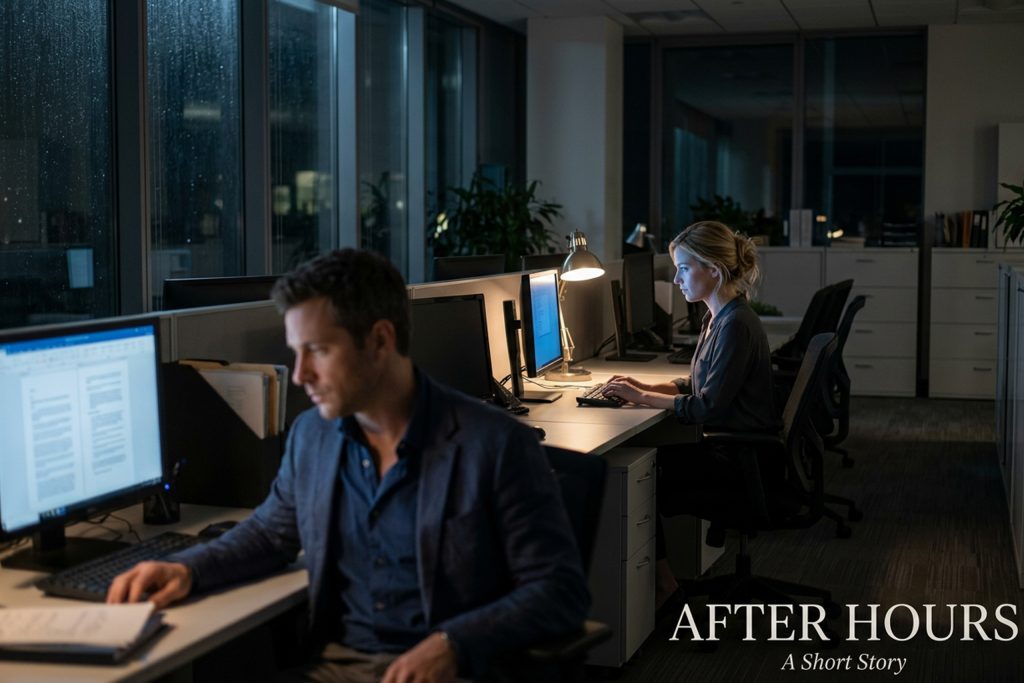
The office was empty by 8:47 PM, which was precisely when Marcus noticed that Sarah from accounting was still at her desk. He’d stayed late to finish the Henderson merger brief — a 200-page document that had consumed his last three weekends and most of his sanity — and he’d assumed he was the last one in the building.
But there she was, her blonde hair catching the blue glow of her monitor, typing with a ferocity that suggested she was either furious or on a deadline. Probably both. Sarah was always on a deadline. She was also always furious, at least in the three years Marcus had worked at Whitfield & Associates.
He didn’t know her well. They’d exchanged maybe twenty words total, most of them in the elevator, most of them about the weather or the broken coffee machine on the third floor. She was quiet, efficient, the kind of person who faded into the background of office life so completely that Marcus sometimes forgot she existed until he saw her name on a spreadsheet.
But tonight, something was different. Maybe it was the empty office. Maybe it was the rain against the windows, drumming a rhythm that made everything feel intimate. Maybe it was just that Marcus was tired and lonely and the sight of another human being at 8:47 PM felt like a gift.
“Hey,” he said, standing in her doorway. “You okay?”
She jumped, her hand flying to her chest, and he felt immediately guilty for startling her.
“Sorry,” he said. “Didn’t mean to scare you.”
“It’s fine.” She took a breath, visibly composing herself. “Just… focused.”
“On what?”
“On not getting fired.” She gestured at her screen. “The Q3 reports are due tomorrow and Johnson accidentally deleted half the database.”
“Johnson from IT?”
“Johnson from IT.”
“Classic Johnson.”
She laughed, a small surprised sound, and Marcus felt something shift in the room, some tension he hadn’t noticed until it was gone.
“I’m Marcus,” he said, even though they both knew that. “From corporate law.”
“I know who you are.” She smiled, and it transformed her face — not a big smile, not a dramatic one, but something genuine that reached her eyes. “You’re the guy who always gets the last croissant.”
“Guilty.”
“I used to hate you for that.”
“Used to?”
“Now I just get here earlier.”
He laughed, surprised by her wit, by the ease of this conversation, by how different she was from the quiet background person he’d imagined her to be.
“Can I buy you a coffee?” he asked. “Since we’re both here and both apparently avoiding our real lives.”
“The machine is broken,” she said. “Third floor. Remember?”
“Right. Classic third floor.” He thought for a moment. “There’s a diner two blocks down. Stays open until midnight.”
She looked at her screen, at the disaster of Q3 reports, at the clock that now read 8:52 PM.
“I really shouldn’t,” she said.
“I know.”
“But…”
“But?”
“But Johnson already deleted the database. How much worse can it get?”
He smiled. “That’s the spirit.”
They walked to the diner in the rain, sharing Marcus’s umbrella, their shoulders brushing with every step. He learned that Sarah was 28, had a degree in statistics she never used, and secretly wrote poetry she was too embarrassed to show anyone. She learned that Marcus was 32, divorced (amicably, he insisted), and had a cat named Chairman Meow who hated him.
The diner was fluorescent and warm, smelling of grease and optimism. They slid into a booth by the window, watching the rain streak the glass, and ordered coffee neither of them really wanted.
“Why corporate law?” she asked, stirring cream into her coffee in slow, hypnotic circles.
“Why accounting?”
“You first.”
“My father was a lawyer. My grandfather was a lawyer. I think my great-grandfather might have been a lawyer, but he also might have been a bootlegger, so the records are unclear.” He shrugged. “It was expected.”
“And you wanted to be…?”
“A jazz musician.”
She laughed, that same surprised sound from the office. “Seriously?”
“I play the saxophone. Badly. But passionately.”
“That’s… not what I expected.”
“No one expects the saxophone.” He smiled. “Your turn. Why accounting?”
“Because numbers make sense.” She looked down at her coffee, and something in her expression shifted, became more serious. “Because numbers don’t lie, don’t cheat, don’t promise things they can’t deliver. Numbers just… are.”
He heard something in her voice — old hurt, carefully buried — and he didn’t push. He just nodded and said, “That makes sense.”
They sat in comfortable silence for a while, watching the rain, listening to the diner’s jukebox play something from the seventies that neither of them recognized.
“Can I ask you something?” she said finally.
“Anything.”
“Why are you really here? At 8:47 PM on a Tuesday? The merger brief?”
“Partly.” He looked at his coffee, at the rings it left on the Formica table. “Mostly because I don’t want to go home to my empty apartment and my cat who hates me.”
She nodded slowly, like this made sense to her, like she understood.
“I don’t want to go home either,” she said. “My roommate has her boyfriend over. Again. They watch reality TV at volumes that suggest hearing damage.”
“So we’re both refugees.”
“Refugees,” she agreed. “Fleeing our own lives for the safety of fluorescent lighting and bad coffee.”
“And each other’s company,” he added, and the words hung in the air between them, neither accusation nor confession, just observation.
She looked at him then, really looked at him, and Marcus saw something in her eyes that he hadn’t expected — recognition, maybe. Or curiosity. Or the beginning of something that could, if they let it, become important.
“Each other’s company,” she repeated, and her voice was softer now, stripped of the dry wit that had carried them through the last hour. “I think I’d like that.”
They left the diner at 10:30 PM, the rain still falling, the city still breathing around them. Marcus offered to walk her home, and she accepted, and they walked the twelve blocks to her apartment building with their shoulders brushing and their hands almost touching and their conversation flowing easier than it had any right to.
At her door, she turned to face him, and the overhead light caught her hair like a halo, and Marcus thought she was the most beautiful thing he’d ever seen in the most ordinary place he’d ever been.
“Thank you,” she said. “For the coffee. For the company. For…”
“For?”
“For seeing me.” She smiled, small and sad and hopeful all at once. “Most people don’t.”
“I see you,” he said. “I’ve been seeing you for three years. I just didn’t know how to say it.”
She reached up, her hand hovering near his face for just a moment before she let it fall. “Goodnight, Marcus.”
“Goodnight, Sarah.”
She opened her door, stepped inside, turned to look at him one last time.
“Same time tomorrow?” she asked, and it was a joke but also not a joke, an invitation disguised as casualness.
“I’ll bring the croissants,” he said.
“You’d better.”
She closed the door, and Marcus stood in the hallway for a full minute, listening to the rain and his own heartbeat, feeling something he hadn’t felt in years. Not desire, exactly, though that was there too. Something more fundamental. Something that had nothing to do with mergers or briefs or corporate expectations.
Connection.
He walked home in the rain, getting wet because he’d left the umbrella with her, not caring about the wet because he was smiling, actually smiling, for the first time in months.
Chairman Meow greeted him at the door with his usual disdain, but even the cat’s contempt couldn’t dim Marcus’s mood. He changed into dry clothes, poured himself a whiskey he didn’t need, and sat by his window watching the rain.
At 11:15 PM, his phone buzzed. A text from a number he didn’t have saved.
“It’s Sarah. From accounting. From the diner. I got your number from the office directory. I hope that’s okay.”
He smiled at his phone like a teenager, like a fool, like a man who had just remembered what it felt like to be alive.
“It’s more than okay,” he typed back. “It’s perfect.”
He fell asleep with his phone in his hand, still smiling, still wet, still hopelessly, wonderfully awake.