


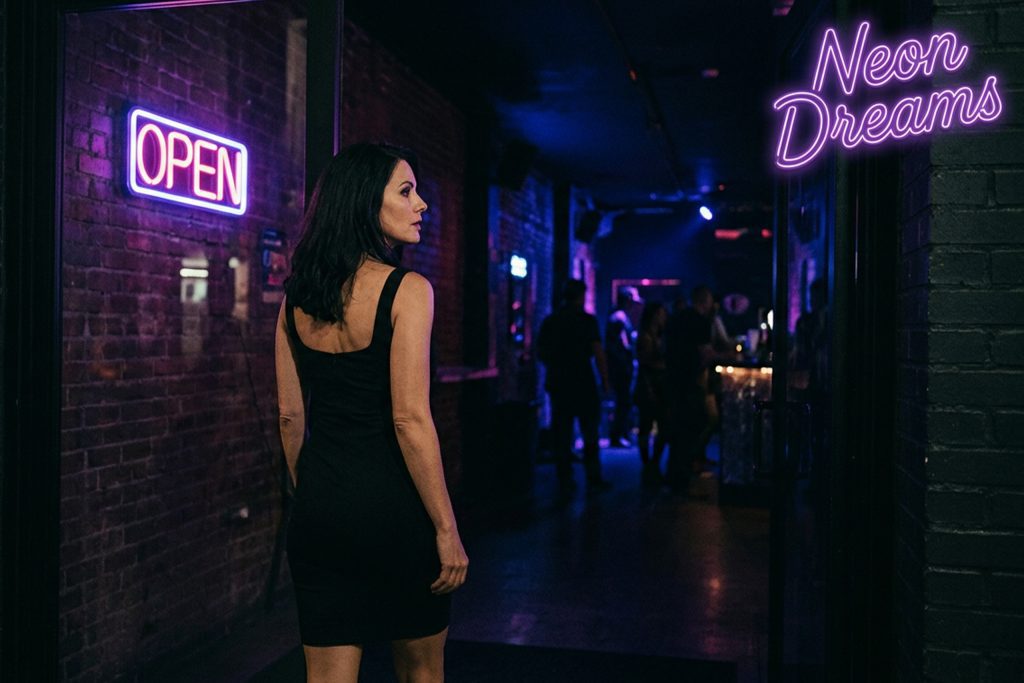
The club didn’t have a name, just a neon sign that read OPEN in flickering pink and a door that led to a staircase that led to a basement that led to another world entirely. Lena had heard about it from a woman she’d met at a gallery opening — a photographer with silver hair and a tattoo of a compass on her wrist who’d said, “If you want to remember what desire feels like, go to the place with no name.”
Lena had laughed, assuming it was a joke. But the woman hadn’t been joking. And now, three weeks later, Lena stood in front of the flickering pink sign, her heart beating a rhythm that matched the bass she could feel through the concrete, wondering if she was brave enough to descend.
She was forty-two, recently divorced, and the last time she’d felt truly desirable was before the invention of smartphones. Her ex-husband had called her “practical” as a compliment and “predictable” as an insult, and she’d spent fifteen years being both, until one day she woke up and realized she’d forgotten the sound of her own heartbeat.
The gallery opening had been her first attempt at remembering. This club — this basement — was her second.
She pushed through the door. She descended the stairs.
The Basement
The room was bathed in neon — pink and blue and purple, colors that didn’t exist in nature, colors that made everyone look like they belonged in a dream. The music was electronic, pulsing, a heartbeat made audible. People moved through the light like fish through water, beautiful and strange and completely unselfconscious.
Lena stood at the edge of the room, feeling overdressed in her black dress and conservative heels, feeling like a tourist in a country where she didn’t speak the language.
“First time?”
She turned. The speaker was a man — maybe thirty, maybe younger, his face painted with streaks of neon blue that caught the light like war paint. He was beautiful in a way that made her feel old and young simultaneously, like she was looking at something forbidden and familiar.
“Is it that obvious?” she asked.
“Only because you’re standing still.” He smiled, and it was kind, not mocking. “Everyone stands still the first time. It’s a lot to take in.”
“What’s this place called?”
“It doesn’t have a name. Everyone calls it something different.” He gestured around the room. “I call it the Aquarium. Because of the lights. Because we’re all just swimming.”
“The Aquarium,” she repeated, and the name felt right, felt like it belonged in her mouth.
“I’m Alex,” he said.
“Lena.”
“What brings you to the Aquarium, Lena?”
She thought about lying. She thought about saying she was here with friends, or that she’d stumbled in by accident, or that she was a journalist doing research. But the neon light made lying feel impossible, made truth feel like the only currency that mattered.
“I forgot what desire feels like,” she said. “Someone told me I could remember here.”
He didn’t laugh. He didn’t look away. He just nodded, like this was the most reasonable thing anyone had ever said to him.
“Then you’re in the right place,” he said. “The Aquarium specializes in remembering.”
The Dance Floor
Alex led her deeper into the room, through the neon light, past couples who moved together like single organisms, past groups of people who laughed with a joy that seemed almost aggressive in its sincerity. The music changed — slower now, more hypnotic — and Alex stopped in the center of the room and turned to her.
“May I?” he asked, extending his hand.
She looked at his hand, at the streaks of neon paint on his palm, at the compass tattoo on his wrist that matched the one the photographer had shown her. She took it.
They didn’t so much dance as sway, their bodies finding a rhythm that existed somewhere between the music and their own heartbeats. Alex’s hand settled on her waist, light and respectful, and Lena felt something she’d almost forgotten — the specific electricity of another person’s skin against hers.
“How long?” he asked, his voice close to her ear.
“How long what?”
“Since you felt desired.”
She closed her eyes. The neon light was still there, pink and blue and purple, painting her eyelids with color.
“Fifteen years,” she whispered. “Maybe longer.”
“That’s a long time to forget.”
“I’m a slow learner.”
He laughed, a sound that vibrated through his chest into hers. “Then we’ll have to be patient teachers.”
“We?”
“The Aquarium,” he said. “Everyone here is a teacher. Everyone here is a student.”
She opened her eyes. The room swam with color, with movement, with the beautiful strangeness of people being exactly who they wanted to be. She saw a woman with silver hair — not her photographer, but someone similar — dancing alone, eyes closed, completely lost in the music. She saw two men kissing in a corner, their hands tangled in each other’s hair, their bodies pressed together like they were trying to occupy the same space. She saw a group of people laughing, passing a bottle of something between them, their joy so contagious that Lena found herself smiling without knowing why.
“I don’t know how to do this anymore,” she said.
“Do what?”
“Want. Be wanted. Feel… alive.”
Alex pulled back just enough to look at her, his eyes catching the neon light and reflecting it back at her, blue and beautiful and completely without judgment.
“You’re already doing it,” he said. “You’re here. You came down the stairs. You took my hand. You’re dancing in a basement full of neon light with a stranger who has paint on his face. That’s more alive than most people manage in a lifetime.”
She felt tears prick her eyes, and she blinked them back, embarrassed.
“Sorry,” she said. “I’m not usually this…”
“This what?”
“This much.”
He smiled, and it was the kindest smile she’d ever seen. “Then it’s been too long since you were this much.”
The Back Room
They moved to a quieter corner, a velvet couch in a space that felt separate from the main room, private without being hidden. Alex brought her water — “You’re dancing, you’re emotional, you’re dehydrated, trust me” — and they sat together in the neon glow, talking about everything and nothing.
He told her he was twenty-nine, a painter who worked nights as a bartender to pay for supplies. He told her he’d been coming to the Aquarium for three years, since he broke up with his boyfriend and needed a place to remember that he was still a person who deserved to be touched.
She told him about the divorce, about the fifteen years of practical predictability, about the gallery opening where a woman with a compass tattoo had told her about a place with no name.
“The photographer,” Alex said, nodding. “Elena. She’s been coming here for decades. She discovered this place when she was our age.”
“Our age,” Lena repeated, and she laughed, because she was forty-two and he was twenty-nine and there was no “our age,” but he said it like it was the most natural thing in the world.
“Age is just…” he started.
“Don’t say age is just a number.”
“I was going to say age is just a story we tell ourselves.” He sipped his water. “But numbers work too.”
She laughed, really laughed, the kind of laugh that came from somewhere deep and genuine, and Alex laughed with her, and for a moment they were just two people on a velvet couch in a neon basement, sharing a joke that wasn’t even that funny, and it was the most perfect moment Lena could remember.
“Can I paint you?” he asked suddenly.
“What?”
“Not literally. Not right now. But someday. Your face, in this light. The way you look when you laugh.” He reached out, his fingers brushing her cheek, the neon paint on his skin leaving a faint blue mark that she didn’t bother to wipe away. “You’re beautiful, Lena. Not despite your age. Because of it. Because of everything you’ve survived to get here.”
She felt the tears again, but this time she didn’t blink them back. She let them fall, let Alex wipe them away with his painted fingers, let herself be seen in a way she hadn’t been seen in years.
“Thank you,” she whispered.
“For what?”
“For seeing me.”
“I see you,” he said. “I’ve been seeing you since you walked down those stairs. You just didn’t know how to look back.”
The Morning After
They didn’t sleep together. Not in the way Lena had expected, not in the way the neon light and the velvet couch and the intimacy of the moment seemed to promise. They talked until 3 AM, until the club began to empty and the neon sign outside flickered its last flicker before going dark.
Then Alex walked her to the subway, his arm linked through hers, their bodies leaning into each other like they’d known each other for years instead of hours.
“Will you come back?” he asked at the entrance to the station.
“To the Aquarium?”
“To me.”
She looked at him — this beautiful painted boy who had seen her, truly seen her, in a basement full of neon light — and she felt something she’d thought was gone forever. Not just desire. Something deeper. Something that started with desire but ended somewhere else entirely.
“Yes,” she said. “I’ll come back.”
He kissed her cheek, the paint on his face cool against her skin, and then he was gone, swallowed by the neon night, leaving her with a blue mark on her cheek and a compass tattoo in her memory and a heart that had finally, finally remembered how to beat.
She rode the subway home as the sun rose, watching the city wake up through dirty windows, and she thought about her ex-husband’s words — “practical,” “predictable” — and she realized they’d never been insults. They’d been challenges. Challenges she’d finally, at forty-two, accepted.
She was going to be impractical. She was going to be unpredictable. She was going to paint her face with neon light and dance in basements and kiss beautiful strangers and remember, every single day, what it felt like to be alive.
When she got home, she looked in the mirror. The blue mark was still there, faint but visible, a reminder of the night she’d stopped being practical and started being real.
She didn’t wash it off. Not yet. She wanted to wear it for a while, this evidence of her own audacity, this proof that she’d gone to the place with no name and found exactly what she was looking for.
Herself.
And the faint, beautiful memory of desire, remembered at last.